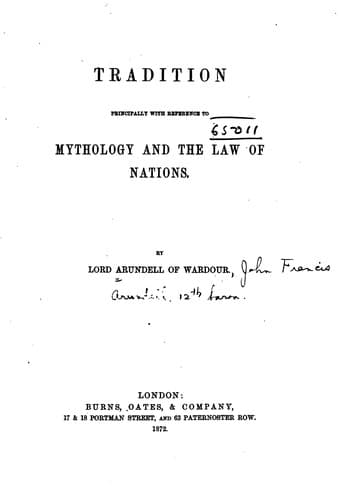
Tradition, Principally with Reference to Mythology and the Law of NationsArundell of Wardour, John Francis Arundell, Baron
Philosophy
Tradition, Principally with Reference to Mythology and the Law of Nations
Arundell of Wardour, John Francis Arundell, Baron
International law; Macdonell, George, 1780-1870; Mythology; Natural law; Tradition (Theology)
Davies' "Celtic Researches," p. 184, says, "Though Hu Gadarn
primarily denoted the Supreme Being [compare chap. ix.], I
think his actions have a secondary reference to the history
of Noah. The following particulars are told of him in the
above-cited selection:--(1.) His branching or elevated oxen
[compare p. 205 and chap. xi.] ... at the Deluge, drew the
destroyer out of the water, so that the lake burst forth no
more [compare chap. iv.] (2.) He instructed the primitive
race in the cultivation of the earth [compare p. 239]. (3.)
He first collected and disposed them into various tribes
[compare p. 239]. (4.) He first gave laws, traditions, &c.,
and adapted verse to memorials [compare p. 239]. (5.) He
first brought the Cymry into Britain and Gaul [compare p.
66], because he would not have them possess lands by war and
contention, but of right and peace" [compare chaps. xiii. and
xv.] It is true that these traditions come to us in ballads
attributed to Welsh bards of the 13th and 14th centuries A.D.;
but, as the Rev. Mr Davies said, "that such a superstition
should have been fabricated by the bards in the middle ages of
Christianity, is a supposition utterly irreconcileable with
probability." And I think the improbability will be widely
extended if the readers will take the trouble, after perusal,
to make the references as above.
My attention was first drawn to the coincidences of mythology with
scriptural history by the late Colonel G. Macdonell.[2] Colonel
Macdonell's coincidences were founded upon a peculiar theory of his
own, and must necessarily have been exclusively upon the lines of
Hebrew derivation. There is nothing, however, in these pages drawn from
that source. I may add, for the satisfaction of Colonel Macdonell's
friends, that as Colonel Macdonell's MSS. exist, and are in the
possession of Colonel I. J. Macdonell, I have (except at p. 243, when
quoting from Boulanger,) expressly excluded the consideration of the
influence of the Hebrew upon general tradition, which, however, will
be necessary for the full discussion of the question.
[2] I have appended a short biographical notice of Colonel G.
Macdonell, which I venture to think may contain matter of
public interest.
Public-domain text, read in full here on John Shaqi.
Reviews
Reviews
No reviews yet
Be the first to share your thoughts on this work.
Join the Discussion
Join the discussion
Sign in to leave a comment or review.
Sign InorCreate an account