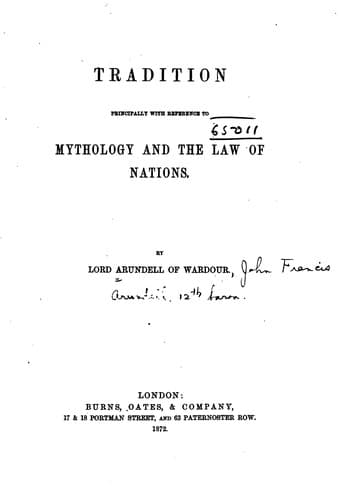
Tradition, Principally with Reference to Mythology and the Law of NationsArundell of Wardour, John Francis Arundell, Baron
Philosophy
Tradition, Principally with Reference to Mythology and the Law of Nations
Arundell of Wardour, John Francis Arundell, Baron
International law; Macdonell, George, 1780-1870; Mythology; Natural law; Tradition (Theology)
"I visited four other villages or _goungs_, and there may be
as many more in Assam, each containing about three or four
hundred people. Every community is under the patriarchal
government of a chief, from whom the village takes its
name.... The chiefs of villages would combine against a
common enemy, but are as independent of each other as the
old Highland heads of clans.... I was curiously reminded
of the clan distinctions, by observing that the home-grown
cotton cloths differed in pattern in the different villages.
In all cases chequered patterns were worn, presenting as
various combinations of colours and stripes as our own
tartans, and each village possessed a pattern peculiar to
itself, generally, though not universally, affected by the
inhabitants."--_Travels in Northern Assam_, Field, i., 1870;
_vide also Hunter's "Rural Bengal,"_ 1868, p. 217.
The same tendencies, under similar circumstances, where the tribes
were not crowded or in fear of warlike neighbours, was noticed among
the Red Indians some forty years ago. Now, I suppose, instances would
be rare.
"When a nation of Indians becomes too numerous conveniently to
procure subsistence from its own hunting-grounds, it is no uncommon
occurrence for it to send out a colony, or, in other words, to
separate into tribes.... The tribe so separated maintains all
its relations independent of the parent nation, though the most
friendly intercourse is commonly maintained, and they are almost
uniformly allies. Separations sometimes take place from party
dissensions, growing generally out of the jealousies of the
principal chiefs, and, not unfrequently, out of petty quarrels.
In such instances, in order to prevent the unnecessary and wanton
effusion of blood, and consequent enfeebling of the nation, the
weaker party moves off usually without the observance of much
ceremony."[26]
Public-domain text, read in full here on John Shaqi.
Reviews
Reviews
No reviews yet
Be the first to share your thoughts on this work.
Join the Discussion
Join the discussion
Sign in to leave a comment or review.
Sign InorCreate an account