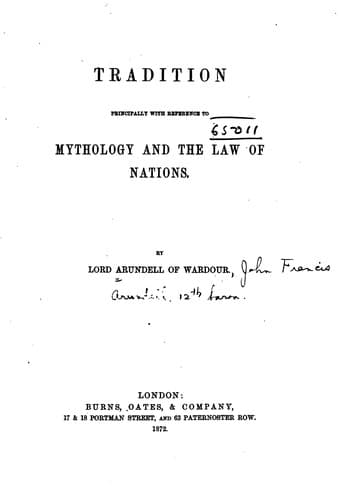
Tradition, Principally with Reference to Mythology and the Law of NationsArundell of Wardour, John Francis Arundell, Baron
Philosophy
Tradition, Principally with Reference to Mythology and the Law of Nations
Arundell of Wardour, John Francis Arundell, Baron
International law; Macdonell, George, 1780-1870; Mythology; Natural law; Tradition (Theology)
Whatever, therefore, Colonel Macdonell may have written will remain
over and above in illustration of the tradition. But whether on the
lines of Hebrew or primeval tradition, these views will inevitably
run counter to the mythological theories now in the ascendant. These
views, indeed, have been so long relegated to darkness, and perhaps
appropriately, on account of their opposition to the prevalent solar
theories, "flouted like owls and bats" whenever they have ventured into
the daylight, that it will be with something amounting to absolute
astonishment that the learned will hear that there are people who still
entertain them: "itaque ea nolui scribere, quæ nec indocti intelligere
possent, nec docti legere curarent" (Cic. Acad. Quæs., 1. i. § 2).
I can sincerely say, however, that although my theories place me in a
position of antagonism to modern science, yet that I have written in no
spirit of hostility to science or the cause of science.
I have throughout excluded the geological argument, for the first and
sufficient reason that I am not a geologist; and secondly, by the
same right and title, that geologists, _e.g._ Sir C. Lyell, in his
"Antiquity of Man," ignores the arguments and facts to which I have
directed special attention.
Nevertheless, I find that competent witnesses have come to conclusions
not materially different from those which have been arrived at, on the
ground of history, within their own department of geology. I have more
especially in my mind the following passage from a series of papers,
"On Some Evidences of the Antiquity of Man," by the Rev. A. Weld, in
the _Month_ (1871), written with full knowledge and in a spirit of
careful and fair appreciation of the evidence. He says:--
"These evidences, such as they are, are fully treated in the work
of Sir C. Lyell, entitled 'Antiquity of Man,' which exhausted the
whole question as it stood, when the last edition was published in
the year 1863. It is worthy of note that though the conclusion at
which the geologist arrives is hesitating and suggestive, rather
than decisive, and though nothing of importance, as far as we are
aware, has been added to the geological aspect of the question
since that time--except that the reality of the discovery of human
remains has been verified, and many additional discoveries of a
similar character have been made--_still the opinion_, which was
_then new and startling, has gradually gained ground_, until we
find writers assuming as a thing that needs no further proof, that
the period of man's habitation on the earth is to be reckoned in
tens of thousands of years."--_The Month_ (May and June 1871), p.
437.
Among various works, bearing on matters contained in these pages, which
have come to hand during the course of publication, I may mention--
"The Mythology of the Aryan Nations," by the Rev. G. W. Cox, referred
to in notes at pp. 158, 165, 396.
The third edition of Sir John Lubbock's "Pre-historic Times."
Public-domain text, read in full here on John Shaqi.
Reviews
Reviews
No reviews yet
Be the first to share your thoughts on this work.
Join the Discussion
Join the discussion
Sign in to leave a comment or review.
Sign InorCreate an account