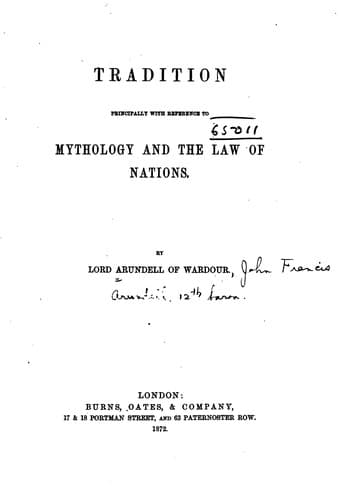
Tradition, Principally with Reference to Mythology and the Law of NationsArundell of Wardour, John Francis Arundell, Baron
Philosophy
Tradition, Principally with Reference to Mythology and the Law of Nations
Arundell of Wardour, John Francis Arundell, Baron
International law; Macdonell, George, 1780-1870; Mythology; Natural law; Tradition (Theology)
Baron Bunsen, we may then assume, has very skilfully brought back
Chinese chronology to within _two generations of Hoang-ti (supra)_.
If we could further identify Hoang-ti with Noah, two patriarchal
generations would bring us close to the date of the Deluge as fixed
by the Septuagint, if we referred them, in the first instance, to the
death of Noah.
Before proceeding to this identification, I must point to another
chronological fact in Chinese tradition, which would give to this
identification an antecedent probability. It was stated (Bunsen,
"Egypt," iii. 383) that Hoang-ti established the _astronomical cycle of
60 years_ in the _sixty-first year_ of his _reign_.
At p. 387, Bunsen says: "The scientific problem thus offered for our
solution is the following--It is admitted that the Chinese, from the
_earliest times_, made use of a sexagesimal cycle for the division
of the year = 6 × 60 days (360 days), and they marked the years by a
cycle of 60 years, running concurrently with the cycle of days. This
cycle, therefore, must have been originally instituted at a time when
the first day of the daily cycle coincided with the first year of
the annual cycle, _i.e._ when they commenced on the same day. Ideler
thinks it impossible to ascertain this, owing to the irregularity of
the old calendar." We may ask, then, what year that could be named
would so exactly satisfy these conditions as the sixty-first year of
the reign of Noah after the Deluge?[51] Let us, moreover, consider how
traditional this cycle of sixty years has been (p. 386),--"Scaliger
made the remark that the twelve yearly zodiacal cycle, which is in
use among the Tartars (Mongols, Mandshus, Igurians), the inhabitants
of Thibet, the Japanese and Siamese dated from _the earliest times_.
Among the Tartaric populations, however, this is a cycle of sixty years
(12 × 5); of the Indians we have already spoken."
[51] Martini ("Historia Sinica," p. 14, edit. Monac.) asserts that
the Egyptians computed by the era of sixty years of _Hoangho_.
See De Vignolle's "Miscellanea Berolinensia," I. iv. 37, on
the cycle of months. Compare Ideler, App. ix., note from
Bunsen, iii. 385. Humboldt ("Vues des Cordillères", p. 149;
Prescott, Mex., i. 105) seems to say that, "among the Chinese,
Japanese, Moghols, Mantchous, and other families of the Tartar
race" (compare Mexican, do.), "their series was composed
of symbols of their five elements, and the twelve zodiacal
signs, making a cycle of sixty years duration." This is not
incompatible with, the allegation that it is "the era of sixty
years of Hoangho."
It will have already been seen that the cycle of sixty years entered
into the Chaldean system--viz. cycle of 60 years = a sossos, 600 years
= a saros, 3600 years = a neros.
Public-domain text, read in full here on John Shaqi.
Reviews
Reviews
No reviews yet
Be the first to share your thoughts on this work.
Elsewhere in the archive
Join the Discussion
Join the discussion
Sign in to leave a comment or review.
Sign InorCreate an account