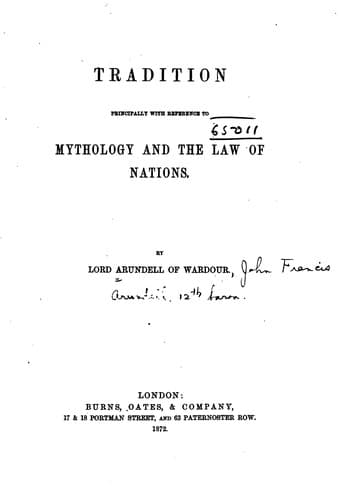
Tradition, Principally with Reference to Mythology and the Law of NationsArundell of Wardour, John Francis Arundell, Baron
Philosophy
Tradition, Principally with Reference to Mythology and the Law of Nations
Arundell of Wardour, John Francis Arundell, Baron
International law; Macdonell, George, 1780-1870; Mythology; Natural law; Tradition (Theology)
"Now when we find (Bunsen, p. 387) that six hundred years _gives
an excess of exactly one lunar month, with far greater accuracy_
than the Julian year, such a cycle must have been indispensable
when that of sixty years was in use, and consequently must have
been employed by the Chinese, or, at all events, have been known to
those from whom they borrowed the latter. Josephus also calls six
hundred years the great year, which may have been observed by the
patriarch."
And at p. 407, in summing up the general chronological result, he
says:--
"_a._ ... The earliest Chinese chronology rests upon a conventional
basis peculiar to itself, that of limiting the lunar year by a
cycle of six hundred years, which is common to the whole of North
Asia and the Chaldeans; and probably (as it is also met with in
India) to the Bactrians also: this basis is _historical_." "_b._
The communication took place before the Chaldees invented the cycle
of six hundred years."
From our point of view, believing that the Chaldees never invented
the cycle but held to it traditionally, the above conclusion must
be construed to mean that the "communication," or diffusion of the
knowledge, must have taken place before the lapse of the first six
hundred years after the Deluge, which will be further confirmed by
conclusion _c._
"_c._ The Chinese observation is based upon the Babylonian gnomon,"
which appears to me tantamount to the admission that it took place, in
the plains of Mesopotamia, previous to the Dispersion.
In arriving, then, at the sixty-first year of the reign of Hoang-ti, we
are led up to such close proximity to the epoch of the Deluge, that
the presumption that Hoang-ti was Noah would be strong, even if no
other evidence was at hand to corroborate it.
It is with this supplementary evidence that I now propose to deal.
Although the tradition of the Chinese is remarkably accurate, up to a
certain point, yet in the period beyond that point, where the confusion
is manifest, there is no reason why we should not expect to find
the same reduplications and amalgamations of ante and post diluvian
traditions, which we have already found in the history of other nations.
Without attempting to unravel all complications, let us turn again to
Bunsen (iii. 382), and setting aside Pu-an-ku, the primeval man who
came out of the mundane egg and lived eighteen thousand years, and who
has resemblances with the Assyrian Ra and Ana, and the Egyptian Ra,
the son of Ptha (to whom thirty thousand are allotted, _vide infra_,
p. 97-100), and Sui-shin, "who discovered fire," and who is the
counterpart of Prometheus (_vide_ p. 180). Regarding
Pu-an-ku, the cosmical, and Sui-shin, as the mythical tradition of
Adam, we come to the historical tradition in the person of Fohi.
Public-domain text, read in full here on John Shaqi.
Reviews
Reviews
No reviews yet
Be the first to share your thoughts on this work.
Elsewhere in the archive
Join the Discussion
Join the discussion
Sign in to leave a comment or review.
Sign InorCreate an account