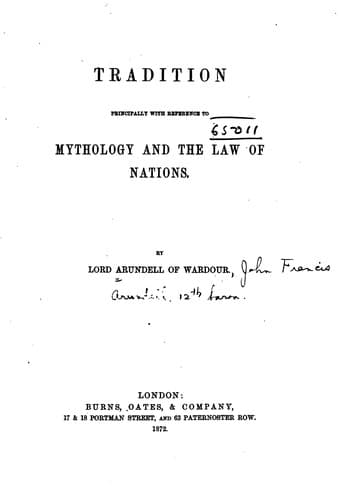
Tradition, Principally with Reference to Mythology and the Law of NationsArundell of Wardour, John Francis Arundell, Baron
Philosophy
Tradition, Principally with Reference to Mythology and the Law of Nations
Arundell of Wardour, John Francis Arundell, Baron
International law; Macdonell, George, 1780-1870; Mythology; Natural law; Tradition (Theology)
"I. Fohi the great, the brilliant (Tai-hao) cultivator of astronomy
and religion, as well as writing. He reigned one hundred and ten
years. Then came fifteen reigns. II. Shin-nong (divine husbandman);
institution of agriculture; the knowledge of simples applied as
the art of medicine." [Compare pp. 210-214, Saturn, Bacchus,
Æsculapius.] "III. Hoang-ti (great ruler) came to the throne in
consequence of an armed insurrection (new dynasty), and was obliged
to put down a revolt. _In his reign_ the magnetic needle was
discovered; _the smelting of copper for making weapons_;[52] vases
of high art, and money; improvement in the written character,
said to be borrowed from the lines on the tortoise-shell. It
consists of five hundred hieroglyphics, of which two hundred
can still be pointed out. He established fixed habitations
throughout his dominions, and the astronomical cycle of sixty
years _in the sixty-first year of his reign_ (_vide supra_, 61);
musical instruments. It was in his time also that the fabulous
bird Sin appeared. The empire was considerably extended to the
_southward_."--_Bunsen_, 382.
[52] This tradition would seem to confirm Bryant's ("Mythology,"
iii. 584) conjecture that Hoang-ti was Ham. But Hoang-ti as
Ham, may absorb and incorporate, as we have seen in other
instances, the history of his progenitors; and, moreover,
whether he is Noah or Ham, would scarcely affect the
chronological argument.
If we take Fohi as Adam, the fifteen reigns which follow will bear
analogy with "the fifteen generations of the Cynic cycle" (_vide_
Palmer i. p. 8, 23-37; also _vide infra_), and will correspond to
the thirteen generations, viz. the ten antediluvian, and the three
survivors (excluding Noah) of the Deluge in the Egyptian chronology
(_vide infra_). Shin-nong, "the divine husbandman,"
will be Noah, and Hoang-ti, Shem or Ham, or else the two will be
reduplicate traditions of Noah. Compare the attributions of Hoang-ti
with those of Hoa in the Assyrian tradition, p. 239. Certain statements
regarding him--_e.g._ that he suppressed an insurrection, accord
more nearly with epithets applied to Nin, the fish-god, whom I have
considered a duplicate of Hoa (p. 201), _e.g._ "the destroyer of
enemies,"--"the reducer of the disobedient,"--"the exterminator of
rebels." Compare with the Phoenician tradition, p. 211, of Saturn
causing the destruction of his son Sadid by the Deluge. The appearance
of the fabulous bird Sin, seems a reminiscence of the birds sent out of
the ark, which is so frequent in tradition. Compare the mystery bird
(the dove) in the Mandan ceremonies,--the worship of the pigeon in
Cashmere,[53] &c. Other coincidences might be pointed if space allowed.
[53] On the worship of the pigeon in Cashmere, _vide_ "Travels in
Kashmir," by G. G. Vigne, Esq., F.G.S., ii. p. 11, 13. 1844.
Public-domain text, read in full here on John Shaqi.
Reviews
Reviews
No reviews yet
Be the first to share your thoughts on this work.
Elsewhere in the archive
Join the Discussion
Join the discussion
Sign in to leave a comment or review.
Sign InorCreate an account