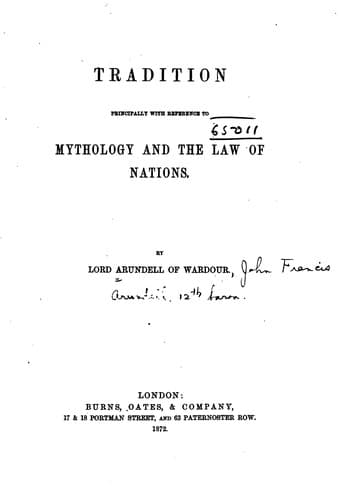
Tradition, Principally with Reference to Mythology and the Law of NationsArundell of Wardour, John Francis Arundell, Baron
Philosophy
Tradition, Principally with Reference to Mythology and the Law of Nations
Arundell of Wardour, John Francis Arundell, Baron
International law; Macdonell, George, 1780-1870; Mythology; Natural law; Tradition (Theology)
"The Emperor said, 'Oh thou Governor of the four mountains of the
Empire!
The swelling flood is producing mischief;
It spreads itself far and wide;
It surrounds the hills, it overflows the dams;
Rushing impetuously along it rises up to Heaven:
The common people complain and sigh.'"
--_Vide supra_, p. 396.
"The venerable Emperor exclaimed with a sigh, 'Ho assistant
Counsellor! the islands great and small up to the _mountain's top_;
The door of _the birds_ and of beasts, all is overflowed together--
Is swamped: be it thy care to open the way, to let off the water.'"
He then says:--
"My task is completed; my _sacrifice_ I have offered in the second
month, trouble is at an end, the dark destiny is changed; the
_streams_ of the south flow down to the sea; garments are prepared;
food is provided; _all the nations_ have rest; the people enjoy
themselves with gambols and dancing."--(Compare Commemorative
Festivals, _infra_, p. 249).
I should have thought that all these phrases pointed much more to a
universal Deluge than to a local inundation. But Bunsen says (398)--
"The fact is fully proved both by the inscription and the work
of Yu itself. The inscription was on the _top_ of the mountain,
Yu-lu-fun, in the district of Shen-shu-lu. Owing to its having
become illegible in early times, it was removed to _the top_
of an adjoining mountain." ... "The former _locality_ tallies
exactly with the very interesting description of the empire in
the time of Yu, which we find at the opening of the second book
of the Shuking." And Bunsen concludes, "It may be presumed after
this verification, that in future nobody will seriously doubt the
strictly epic description of the Shuking in the Canon of Yu," as
above.
So far from being impressed by the discovery of the monument on the
top of the local mountain, as evidence of the local deluge, I can
see in it only a memorial of the universal Deluge localised; and I
cannot help considering it in connection with the worship of the tops
of mountains, of which we shall find traces elsewhere (p. 244-46).
Surely Baron Bunsen proves too much, and describes to us a deluge which
must have been on the scale of the universal Deluge for all countries
below the level of the mountain Yu-lu-fun. But, let it be said, that
this description, so accordant with the description of the flood, was
merely Chinese exaggeration. I here wish to point out two curious
coincidences. What if we shall find works similar of those to Yao or
Yu, ascribed to the original founders in Egypt and Cashmere? As in the
first instance, I shall have to quote from Baron Bunsen himself, I am
surprised that the coincidence should have escaped his observation.
Public-domain text, read in full here on John Shaqi.
Reviews
Reviews
No reviews yet
Be the first to share your thoughts on this work.
Elsewhere in the archive
Join the Discussion
Join the discussion
Sign in to leave a comment or review.
Sign InorCreate an account