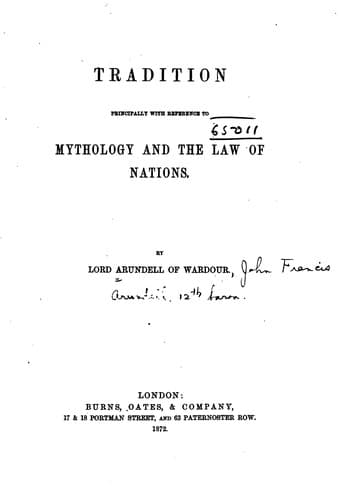
Tradition, Principally with Reference to Mythology and the Law of NationsArundell of Wardour, John Francis Arundell, Baron
Philosophy
Tradition, Principally with Reference to Mythology and the Law of Nations
Arundell of Wardour, John Francis Arundell, Baron
International law; Macdonell, George, 1780-1870; Mythology; Natural law; Tradition (Theology)
"This is the account given of Menes [the first king of Egypt] by
Herodotus--Menes, the first king of Egypt, as the priests informed
me, protected Memphis by a dam against the river which ran towards
the sandy chain of the Libyan Mountains. About 100 stadia above
Memphis, he made an embankment against the bend of the river,
which is on the south side. The effect of this was to dry up its
ancient bed, as well as to force the stream between the two chains
of mountains. This bend of the Nile, which is confined within the
embankment walls, was very carefully attended to by the Persians,
and repaired every year. For, if the river were to burst through
its banks and overflow at this point, all Memphis would be in
danger of being swamped. Menes, _the oldest of their kings_, having
thus drained the tract of land by means of the dyke, built upon
it the city now called Memphis, which lies in the mountain valley
of Egypt. To the west and north he dug a lake round it, which
communicates with the river--on the east it is bounded by the
Nile--and afterwards erected in it a temple to Vulcan, a splendid
edifice, deserving of especial notice" (ii. 48).
Bunsen fully endorses this account--"Herodotus, therefore, has
recorded the following fact, that before the time of Menes the Nile
overflowed the tract of country which he fixed upon as the site of his
new metropolis" (p. 49 and p. 51). "There is no foundation whatever
for Andriossy's hypothesis that the story originated in the fact of
the Nile having once run westward from the Pyramid mountains to Bahr
Bela Ma (stream without water) and the Natron and Mareotic Lakes.
Herodotus mentions an historical fact, and describes the work of an
historical king. Andriossy's hypothesis, if well founded, would belong
to geology." A sagacious and well-founded remark on the part of Baron
Bunsen, but, as I submit, equally applicable to the work of Yao or Yu.
Merely noting that, if the above work was really carried out by Menes,
and it would have been, from the point of view of Genesis, so carried
out at a period contemporary with that of Yao or Yu--and, moreover,
conceding to it in any case (I mean the work of Menes) a certain
historical basis--let us dispassionately compare both with the passage
from Klaproth, which I shall now extract. It is taken from the Sanscrit
History of Cashmere.[55]
[55] Klaproth says:--"The only Sanscrit history deserving the name
of the chronicle of the kings of Kashmir, Radja Paringin'i,
translated by W. H. Wilson."--_Klaproth, Mem. Relatif à
L'Asie_.
Klaproth says:--
Public-domain text, read in full here on John Shaqi.
Reviews
Reviews
No reviews yet
Be the first to share your thoughts on this work.
Elsewhere in the archive
Join the Discussion
Join the discussion
Sign in to leave a comment or review.
Sign InorCreate an account