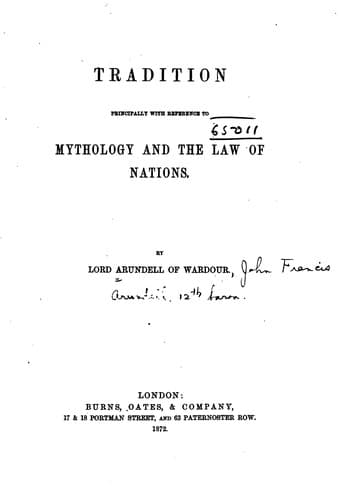
Tradition, Principally with Reference to Mythology and the Law of NationsArundell of Wardour, John Francis Arundell, Baron
Philosophy
Tradition, Principally with Reference to Mythology and the Law of Nations
Arundell of Wardour, John Francis Arundell, Baron
International law; Macdonell, George, 1780-1870; Mythology; Natural law; Tradition (Theology)
"The sceptical effects of the discoveries of science, and the
uneasy feeling that they cannot co-exist with our old religious
convictions have their origin in the circumstance that the general
body who have suddenly become conscious of these physical truths
are not so well acquainted as is desirable with the past history
of man. Astonished by their unprepared emergence from ignorance to
a certain degree of information, their amazed intelligence takes
refuge in the theory of what is conveniently called progress, and
every step in scientific discovery seems further to remove them
from the path of primæval inspiration. But there is no fallacy
so flagrant as to suppose that the modern ages have the peculiar
privilege of scientific discovery, or that they are distinguished
as the epochs of the most illustrious inventions. On the contrary,
scientific invention has always gone on simultaneously with the
revelation of spiritual truths; and more, the greatest discoveries
are not those of modern ages. No one for a moment can pretend
that printing is so great a discovery as writing, or algebra as
language. What are the most brilliant of our chemical discoveries
compared with the invention of fire and the metals? It is a vulgar
belief that our astronomical knowledge dates only from the recent
century, when it was rescued from the monks who imprisoned Galileo;
but Hipparchus, who lived before our Divine Master, and who, among
other sublime achievements, discovered the precession of the
equinoxes, ranks with the Newtons and the Keplers; and Copernicus,
the modern father of our celestial science, avows himself, in his
famous work, as only the champion of Pythagoras, whose system he
enforces and illustrates. Even the most modish schemes of the day
on the origin of things, which captivate as much by their novelty
as their truth, may find their precursors in ancient sages; and
after a careful analysis of the blended elements of imagination and
induction which characterise the new theories, they will be found
mainly to rest on the atom of Epicurus and the monad of Thales.
Scientific, like spiritual truth, has ever from the beginning
been descending from Heaven to man. He is a being who organically
demands direct relations with his Creator, and he would not have
been so organised if his requirements could not be satisfied. We
may analyse the sun and penetrate the stars; but man is conscious
that he is made in God's own image, and in his perplexity he will
ever appeal to our Father which art in Heaven."
MEMOIR
OF
COLONEL GEORGE MACDONELL, C.B.
Public-domain text, read in full here on John Shaqi.
Reviews
Reviews
No reviews yet
Be the first to share your thoughts on this work.
Join the Discussion
Join the discussion
Sign in to leave a comment or review.
Sign InorCreate an account