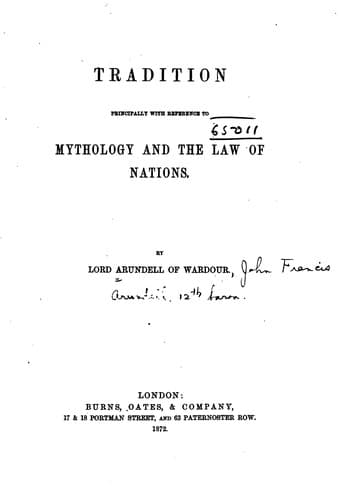
Tradition, Principally with Reference to Mythology and the Law of NationsArundell of Wardour, John Francis Arundell, Baron
Philosophy
Tradition, Principally with Reference to Mythology and the Law of Nations
Arundell of Wardour, John Francis Arundell, Baron
International law; Macdonell, George, 1780-1870; Mythology; Natural law; Tradition (Theology)
The following notice appeared in the _Times_, May 23, 1870--"In our
obituary column of Saturday we announced the death of Colonel George
Macdonell, C.B., at the advanced age of ninety. This officer, who
was a cadet of the ancient and loyal Scottish house of Macdonell of
Glengarry, was the son of an officer who served under the flag, and
who, as we have been told, was on the staff, of Prince Charles Edward
Stuart at the battle of Culloden, where he was severely wounded.
His son, the Colonel now deceased, was born in 1779, or early in
the following year; obtained his first commission in 1796, and was
nominated a Companion of the Bath in 1817. He saw active service in the
war in North America with the 79th Foot, and received the gold medal
for the action at Châteaugay; and had he not accepted the retirement a
few years since, he would have been, at his death, almost the senior
officer in the army holding Her Majesty's commission. The late Colonel
Macdonell, who adhered to the Roman Catholic religion professed by his
ancestors, and for which they fought so gallantly under the Stuart
banners, married, in 1820, the Hon. Laura Arundell, sister of the Lord
Arundell of Wardour, but was left a widower in May 1854." His son,
Colonel I. J. Macdonell, now commands the 71st Highlanders.
I take this opportunity of adding a few facts, not without interest,
to the above brief summary of a not uneventful life, as they
might otherwise pass unrecorded. In the sentiment of the Gaelic
saying--"Curri mi clach er do cuirn" (Wilson, "Archæol. Scot.," p.
59)--"I will add a stone to your cairn."
Colonel Macdonell's father, as stated in the above account, was wounded
at Culloden in the thigh, but was able to crawl on all-fours, after
the battle, eighteen miles, to a barn belonging to a member of the
Grant family. He there remained in concealment for six months, leaving
nature to heal the wound; but the search in the neighbourhood in time
becoming too hot, he had to decamp, and walked with a stick all the way
to Newcastle, where he was not greatly re-assured by meeting a soldier
who had just been drummed out of his regiment as a Catholic, with the
word "Papist" placarded on his back. He, however, escaped all dangers,
and reached Hull, and subsequently Versailles or St Germains, where he
remained three years, or at least till the events following the Peace
of Aix-la-Chapelle dispersed the Prince's adherents. He then returned
to England under the Act of Indemnity, entered the royal army, and
was present with General Wolfe at the taking of Quebec. If I remember
rightly, he had the good fortune to take an aide-de-camp of Montcalm's
prisoner, with important dispatches.
Public-domain text, read in full here on John Shaqi.
Reviews
Reviews
No reviews yet
Be the first to share your thoughts on this work.
Join the Discussion
Join the discussion
Sign in to leave a comment or review.
Sign InorCreate an account