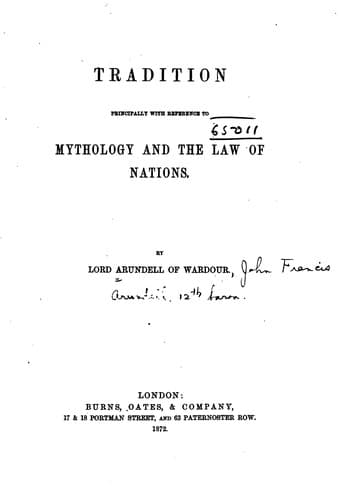
Tradition, Principally with Reference to Mythology and the Law of NationsArundell of Wardour, John Francis Arundell, Baron
Philosophy
Tradition, Principally with Reference to Mythology and the Law of Nations
Arundell of Wardour, John Francis Arundell, Baron
International law; Macdonell, George, 1780-1870; Mythology; Natural law; Tradition (Theology)
"The _Hindoo_ history of Kashmir assures us that the beautiful
valley which forms this kingdom was originally a vast lake, called
Satisaras. This account is also agreeable to the _local traditions_
of this country. It was Kasy'apa, _a holy person_ who, according
to the Hindoo historians, caused the waters which covered this
valley to escape. He was the son of _Marichi_, the son of Brahma.
The Mahometan writers call him Kachef or Kacheb, and many of them
pretend that he was a god, or a genius, and servant of Soliman,
_under whose orders he effected_ the drying up of Kashmir. To
execute _this task_ he made, near Baramanleh, _a passage across
the mountains_, through which the water passed.... The territory,
recovered in this way by Kasy'apa, _was also peopled_ by this holy
man, with the assistance of the superior gods, whom he brought for
this purpose from heaven, _at the commencement_ of the seventh
manwantara, or that in which we are now." Klaproth adds:--"We must
therefore suppose that Kashmir has been subjected to the same
periodical revolutions as the other parts of the world, if we would
reconcile this date with the ordinary chronology."[56]
[56] Compare the following account of existing customs in
Cashmir with the above extract from Klaproth and ch. xi.,
with commemorative festivals of the Deluge. Mr G. G. Vigne
("Travels in Kashmir," ii. 93) says:--"What has been
poetically termed the feast of roses, has of late years been
rather the feast of signaras or _water_-nuts. It is held, I
believe, about the 1st May, when plum-trees and roses are in
full bloom, and is called the Shakergal, from the Persian
shakergan, to blow a blossom [the Mandan ceremony took place
when the willow flowered.--Catlin, p. 6]. The richer classes
come in _boats_ to the foot of the Tukt, ascend it, and
have a feast upon _the summit_, eating more particularly of
signaras (_water_-nuts). The feast of the No-warh (new place)
takes place at the vernal equinox [compare Noah, Taurus], at
_which period_ the _valley is said to have been drained_. It
is held chiefly at the _But_ or idol stone on Hari par_but_."
Query--Can this be "the ark or big canoe" in the Mandan
celebration? Considering the prominence of boats in all these
mysteries, and considering the resemblance of but to boat, and
the like analogies in so many languages (Sanskrit, pota = boat)
(_vide_ Vicomte d'Anselme, _infra_, p. 196), may we be
permitted the conjecture until corrected. Compare also p. 268,
Ogilby's "Japan," Cook. &c., p. 271.
Public-domain text, read in full here on John Shaqi.
Reviews
Reviews
No reviews yet
Be the first to share your thoughts on this work.
Elsewhere in the archive
Join the Discussion
Join the discussion
Sign in to leave a comment or review.
Sign InorCreate an account