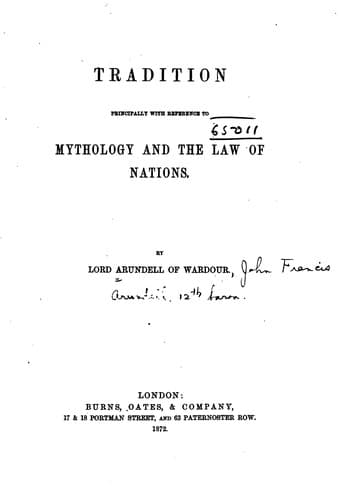
Tradition, Principally with Reference to Mythology and the Law of NationsArundell of Wardour, John Francis Arundell, Baron
Philosophy
Tradition, Principally with Reference to Mythology and the Law of Nations
Arundell of Wardour, John Francis Arundell, Baron
International law; Macdonell, George, 1780-1870; Mythology; Natural law; Tradition (Theology)
[68] The expressions in the latter part of this narration recall
the blessing of Jacob, and suggests the possibility of the
tradition having come through descendants of Esau.
Cardinal Wiseman (in his "Science and Revealed Religion," lect. iii.),
says, with reference to Aristotle's distribution of mankind into races
by colour:--
"There is a passage in Julius Firmicus, overlooked by the
commentators of Aristotle, which gives us the same ternary
division, with the colours of each race. 'In the first place,' he
writes, 'speaking of the characters and colours of men, they agree
in saying,--if by the mixed influence of the stars, the characters
and complexions of men are distributed; and if the course of the
heavenly bodies, by a certain kind of artful painting, form the
lineaments of mortal bodies; that is, if the moon makes men white,
Mars red, _and Saturn black_, how comes it that in Ethiopia all are
born black, in Germany white, and in Thrace red?'"--_Astronomicon_,
lib. i., c. i., ed. Basil. 1551, p. 3.
Now this passage seems to me to have a still further significance in
the words I have italicised, with reference to the argument I have in
hand. It transpires, therefore, that the ancients had the notion that
Saturn made men black, which provoked the natural query, why then are
only the Ethiopians black? That it should ever have been supposed that
the distant Saturn, astronomically regarded, should have had such an
influence is preposterous, but if the mythological personage, Saturn,
ch. x., has been sufficiently identified with Noah, and the deification
of the hero in the planet (comp. pp. 159, 161) probable, the notion
that _he made men black_, must be the tradition of the event we are
considering.
I have elsewhere traced the fulfilment of the text which says that
Canaan shall be the "servant of servants to his brethren;" but as the
following extract from Klaproth, in evidence of the same, has also its
significance with reference to the point I am now considering--viz.
the curse of blackness--I prefer to give it a place here:--"Sakhalian
oudehounga est expliqué en Chinois par 'Khian chéon,' et par 'li chu,'
ce qui signifie les '_têtes noires_' et le '_peuple noir_,' expression
par laquelle on designe la 'bas peuple' ou les 'paysans.' Cette
une expression _usitée dans plusieures pays Asiatiques ainsi qu'en
Russie."--Klaproth, "Mem. Relatif a l'Asie;" vide strictures on Pere
Amyot's "Mandchou Dict_."
Public-domain text, read in full here on John Shaqi.
Reviews
Reviews
No reviews yet
Be the first to share your thoughts on this work.
Elsewhere in the archive
Join the Discussion
Join the discussion
Sign in to leave a comment or review.
Sign InorCreate an account