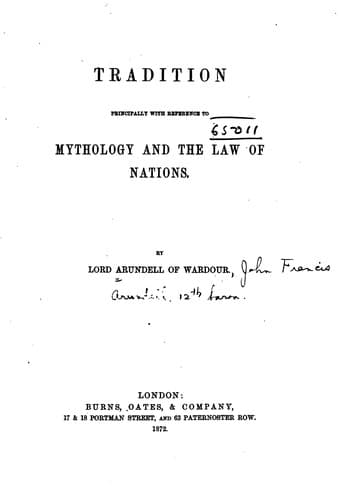
Tradition, Principally with Reference to Mythology and the Law of NationsArundell of Wardour, John Francis Arundell, Baron
Philosophy
Tradition, Principally with Reference to Mythology and the Law of Nations
Arundell of Wardour, John Francis Arundell, Baron
International law; Macdonell, George, 1780-1870; Mythology; Natural law; Tradition (Theology)
In the oldest books of the Zendavasta, virtue and vice are personified
as white and black. "The contrast between good and evil is strongly and
sharply marked in the Gâthâs.... They go a step further and personify
the two parties to the struggle. One is a 'white,' or holy spirit
(_spentô mainyus_), and the other, a 'dark' spirit (_angrô mainyus_).
But this personification is merely poetical or metaphysical, not
real."--_Rawlinson's "Ancient Monarchies_," iii. p. 106. The contrast,
however, between good and evil, as white and black was the genuine
expression of their idea or tradition. (Hung. ap. Bunsen, iii. p. 476,
admits, at least in one instance in the Gâthâs, "an angra ('black') is
put in opposition to the white, or more holy spirit.")
Mr Hunter ("Rural Bengal," p. 114) says of the primitive Aryans in
India--"The ancient singer praises the _god_ who 'destroyed the Dasyans
and protected the _Aryan colour_" (Rig. Veda., iii. pp. 34-39), and
"the thunderer, who bestowed on his white friends the fields," &c.
Whatever obscurity may attach to the latter passage, there can be no
doubt of the abhorrence with which the singers speak, _again_ and
_again_, of "_the black skin_," ... _e.g._ "the sacrificer poured
out thanks to his god for 'scattering the _slave_ bands of _black
descent_.'"
Although I believe the idea was traditional and had reference to the
curse, I will concede that it might have arisen primarily in the
contrast of night and day, light and darkness. But does this settle the
question? On the contrary, fortified with this explanation, I return to
my argument with those, who say that blackness is a mere prejudice of
race, and that it is not demonstrable that it is the sign of a curse,
or the mark of inferiority. Does not Nature herself proclaim it, in
her contrast of light and darkness? Day and night, I imagine, would be
recognised as apt symbols of error and evil as opposed to truth and
goodness, even among the black races, irrespective of any consciousness
or reminiscence of their degradation. Accordingly, the deeds of evil
in Scripture are spoken of as the "works of darkness." It may be,
therefore, that the idea of blackness as a curse is derived primitively
from its association with the darkness of night; but the fact remains
that blackness is connected in our minds with a curse,[69] and there
is the further fact that a black race exists, and has existed during
four thousand years, with this mark of inferiority upon it (compare
_sup._ ch. iii. ix.)
Public-domain text, read in full here on John Shaqi.
Reviews
Reviews
No reviews yet
Be the first to share your thoughts on this work.
Elsewhere in the archive
Join the Discussion
Join the discussion
Sign in to leave a comment or review.
Sign InorCreate an account