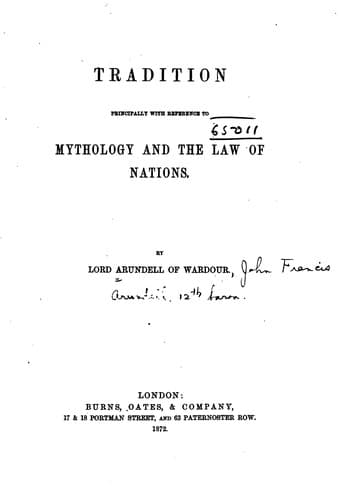
Tradition, Principally with Reference to Mythology and the Law of NationsArundell of Wardour, John Francis Arundell, Baron
Philosophy
Tradition, Principally with Reference to Mythology and the Law of Nations
Arundell of Wardour, John Francis Arundell, Baron
International law; Macdonell, George, 1780-1870; Mythology; Natural law; Tradition (Theology)
[69] This is so much in tradition as to be a matter of common
parlance--for instance, when the late Emperor of the French
is depicted, this is the language which, upon a certain
construction, appears most natural--"On the other side stands
a phalanx of satirists, represented by Victor Hugo. The only
colour on the palette of those artists is _lamp black_.
Morally they paint the ex-Emperor as _dark as a negro_, array
him _in the livery of the devil_, and _then_ invoke the
_execration_ of history."--_Spectator_, Sept. 17th, 1870.
But a point of some difficulty remains to be determined--viz. what
precisely was the race which came under this ban. Was it the whole
descent of Ham, or only the posterity of Chanaan ?
Hales, in his learned work on chronology (i. p. 344), discusses this
question. He says that, whereas--
"Even the most learned expositors (Bochart and Mede) have
implicitly adopted the appropriation of the curse of servitude to
Ham and his posterity." Yet "the integrity of the received text of
prophecy, limiting the curse to 'Canaan' singly, is fully supported
by the concurrence of the Massorite and Samaritan Hebrew texts,
with _all the other_ ancient versions except the Arabian; and is
acknowledged, we see, by Josephus and Abulfaragi (_sup._), who
evidently confine the curse to Canaan--though they inconsistently
consider Ham as the offender, and are not a little embarrassed to
exempt him and _the rest of his children_[70] from the operation
of the curse--an exemption, indeed, attested by sacred and profane
history; for Ham himself had his full share of earthly blessings,
his son Misr colonised Egypt, thence styled the land of Ham (Ps.
cv. 23), which soon became one of the earliest, most civilised,
and flourishing kingdoms of antiquity, and was established before
Abraham's days (Gen. xii. 14-20), and in the glorious reign of
Sesostris ... while Ham's posterity, in the line of Cush, not only
founded the first Assyrian empire, under Nimrod, but also the
Persian (?), the Grecian (?), and the Roman (?) empires, in direct
contradiction to the unguarded assertion of Mede [that 'there
hath never yet been a son of Ham that hath shaken a sceptre over
the head of Japheth.'] How, then, is the propriety of the curse
exclusively to Canaan to be vindicated?--evidently by considering
him as the only guilty person ... upon the very ingenious
conjecture of Faber, that the 'youngest son' who offended was not
Ham, but Canaan--not the son, but the grandson of Noah. For the
original, 'his little son,' according to the latitude of the Hebrew
idiom, may denote a grandson, by the same analogy that Nimrod....
this (the former) interpretation is supported by ancient Jewish
tradition, 'Boresith Rabba,' sec. 37, recorded also by Theodoret
... the tradition, indeed, also adds that Ham joined in the
Public-domain text, read in full here on John Shaqi.
Reviews
Reviews
No reviews yet
Be the first to share your thoughts on this work.
Elsewhere in the archive
Join the Discussion
Join the discussion
Sign in to leave a comment or review.
Sign InorCreate an account