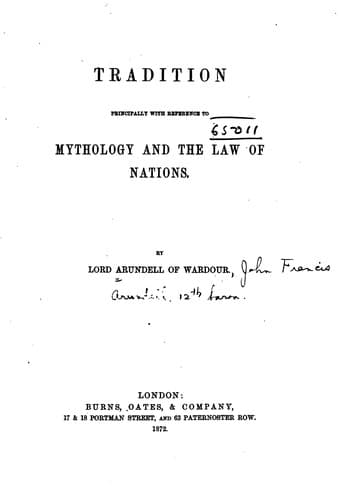
Tradition, Principally with Reference to Mythology and the Law of NationsArundell of Wardour, John Francis Arundell, Baron
Philosophy
Tradition, Principally with Reference to Mythology and the Law of Nations
Arundell of Wardour, John Francis Arundell, Baron
International law; Macdonell, George, 1780-1870; Mythology; Natural law; Tradition (Theology)
mockery, but for this addition there seems no sufficient grounds."
[70] The italics are mine.
There is, however, the tradition, and, moreover, a distinct tradition
that Ham was black. Sir J. Gardner Wilkinson, in his "Manners and
Customs of the Ancient Egyptians," i., says--
"The Hebrew word Ham is identical with the Egyptian Khem, being
properly written Khm, Kham, or Khem, and is the same which the
Egyptians themselves gave to their country in the sculptures of
the earliest and latest periods" (261). Egypt was denominated
Chemi (Khemi), or the land of Ham, "as we find in the hieroglyphic
legends; and the city of Khem, or Panopolis, was called in
Egyptian Chemmo, of which evident traces are preserved in that of
the modern town E'Khmim" (260). "Besides the hieroglyphic group,
composed of the two above alluded to (260), indicating Egypt, was
one consisting of _an eye_, and the sign land, _which bore the
same_ signification; and since _the pupil_, or _black_ of the eye,
was called _Chemi_, we may conclude this to be a phonetic mode
of writing the name of Egypt, which Plutarch pretends was called
Chemmia, from the _blackness_ of its soil" (263). "_Chame_ is
_black_ in _Coptic_, Egypt is _Chemi_, and it is remarkable that
_khom_ or _chom_ is used in Hebrew for black or brown, as in Gen.
xxx. 32-40."--_Id._
Here then, at any rate, the name of Ham or Cham is curiously associated
with blackness, and must have been so associated from the commencement
of Egyptian history. I leave it to the Egyptologist to decide whether
the presumption is stronger that the name of Egypt, identical with
that of Ham, was originally derived from the blackness of its soil,
or from the blackness of him whose name was identical with it ("the
land of Ham" being both the scriptural and Egyptian appellation),
more especially when "the eye" (apparently a personal or historical,
not certainly a geographical allusion) was used as an equivalent
hieroglyphic symbol for land.[71]
[71] The eye would be the very most apposite symbol for blackness,
if we consider that blackness lingers there after the skin has
become white, and, in the case of half-breeds, is the test of
descent in gradations even beyond, I believe, the octoroon.
Captain King ("Narrative of a Survey of the Intertropical
and Western Coasts of Australia," ii. Append.) says, "That
although there is the greatest diversity of words among the
Australian tribes, the equivalent for 'eye' is common to them
all."
Public-domain text, read in full here on John Shaqi.
Reviews
Reviews
No reviews yet
Be the first to share your thoughts on this work.
Elsewhere in the archive
Join the Discussion
Join the discussion
Sign in to leave a comment or review.
Sign InorCreate an account