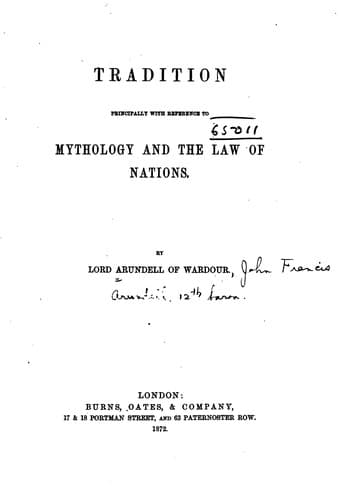
Tradition, Principally with Reference to Mythology and the Law of NationsArundell of Wardour, John Francis Arundell, Baron
Philosophy
Tradition, Principally with Reference to Mythology and the Law of Nations
Arundell of Wardour, John Francis Arundell, Baron
International law; Macdonell, George, 1780-1870; Mythology; Natural law; Tradition (Theology)
Here, as in other instances, if we follow the strict lines of
tradition, it seems to me that we shall escape all the difficulties
which are usually alleged against it. It will result then that,
although according to the text of Scripture, the curse of servitude was
limited to the posterity of Chanaan; yet, seeing that the criminality
was common to Ham and Chanaan, according to the tradition referred to,
and as is, moreover, implied in the marked manner in which Scripture
(Gen. xviii. 22) indicates Cham as "the father of Chanaan," it is
presumable that, if blackness was the concomitant of the curse, it
extended to both Ham and Chanaan, and, by implication, to their
posterity, but then _after the curse_. As Chanaan, according to the
tradition, was then a boy, all his children would have been affected
by the curse; but does it follow that all Ham's descent was involved
in the malediction? This would be to suppose a retrospective curse,
for which the only analogy would be the hypothesis that if Adam had
sinned after the birth of Cain and Abel, they and their posterity would
also have incurred the guilt of original sin. Now the sons of Ham were
(Gen. x. 6) "Chus and Mesram and Phuth and Chanaan," _i.e._, Chus and
Mesram and Phuth were the elder brothers of Chanaan, and therefore not
the children of Ham after the pronouncement of the curse. If, then, we
find the children of Mesram dark, but without the negro features or
the blackness of Canaan; if "Sesostris, his descendant, was a great
conqueror;" if Nimrod, the son of Chus, was a powerful chieftain,
and the founder of the Assyrian empire; if nothing is known of the
posterity of Phuth beyond the conjecture that they were the Lybians--in
a word, if the descent from these three sons does not bear out the
evidence of the curse, can it be said to militate at all against the
hypothesis of the curse of Ham as well as of Canaan?
Moreover, if there are differences among the black races which may
present difficulties, would not the knowledge that there may have been
a posterity of Ham, born after the curse,[72] go far to remove them?
Hales, indeed, assumes that "Ham himself had his full share of earthly
blessings; his son Misr colonised Egypt," &c. (as _sup._); but this
prosperity, as he indicates it, is only seen in the prosperity of his
three sons, whom I assume to have been exempt from the curse. It must
be remembered, however, that the occult science of the Cainites was
said to have been preserved by the family of Ham, and, as we have seen,
the taint was in the race.[73]
Public-domain text, read in full here on John Shaqi.
Reviews
Reviews
No reviews yet
Be the first to share your thoughts on this work.
Elsewhere in the archive
Join the Discussion
Join the discussion
Sign in to leave a comment or review.
Sign InorCreate an account