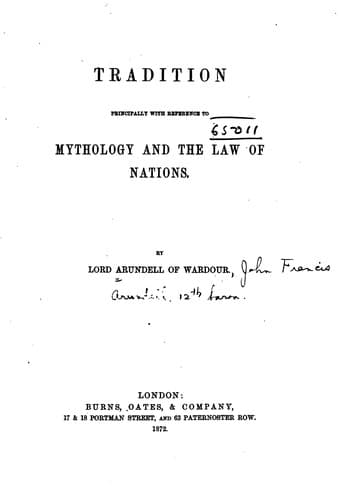
Tradition, Principally with Reference to Mythology and the Law of NationsArundell of Wardour, John Francis Arundell, Baron
Philosophy
Tradition, Principally with Reference to Mythology and the Law of Nations
Arundell of Wardour, John Francis Arundell, Baron
International law; Macdonell, George, 1780-1870; Mythology; Natural law; Tradition (Theology)
[72] Lenormant, "Manuel d'Histoire Ancienne," i. 23, makes a
similar suggestion as to this point--"La texte de la Bible
n'a rien qui s'oppose formellement à l'hypothèse que Noè
aurait eu, postérieurement au deluge, d'autres enfants que
Sem, Cham, et Japhet, d'où seraient sorties les races qui ne
figurent pas dans la généalogie de ces trois personnages." But
two objections seem to me to be fatal to this view. The races
about whom this difficulty would be raised would be the red
and black races: why should it be surmised that the supposed
posterity of Noah, after the Deluge, _should_ have this mark
of inferiority? In the second place, it does seem to be
formally opposed to Gen. x. 32--"These are the _families_ of
_Noe_, according to their peoples and nations. _By these_ were
the nations divided on the earth after the flood."
The red races might perhaps be accounted for by Gen. xxv.
23-25.
[73] There appears to me, however, a text to which attention
might be directed. We know that the Ethiopians were black,
but in Amos ix. 7, where God is expressing His anger against
His people, He says, "Are you not as the children of the
Ethiopians unto me, O children of Israel, saith the Lord."
I am very far from claiming for these theories any special
ecclesiastical countenance and authority. I have already intimated my
opinion that, on the whole, they would be as much opposed from the
point of view of scriptural exegesis as from that of unbelief. It will
be said, for instance, that there is evidence in Scripture of the curse
of Canaan, but no proof that blackness was the concomitant effect of
the curse; and certainly it is not Scripture which affirms this, but
only tradition.
To those who admit the curse, but deny the consequences which tradition
attributes to it, I would oppose an almost identical argument with that
which accounts for all differences in the human race by geographical
location. I do not know where this argument is more forcibly put than
in Latham's "Ethnology." There it is seemingly demonstrated that
certain conditions, not merely of colour, but moral and intellectual,
are the inseparable accompaniments of geographical location. Grant it,
_pro argumento_, but I am arguing now upon the scriptural evidence, and
with one with whom I assume I have a common belief in its inspiration.
Public-domain text, read in full here on John Shaqi.
Reviews
Reviews
No reviews yet
Be the first to share your thoughts on this work.
Elsewhere in the archive
Join the Discussion
Join the discussion
Sign in to leave a comment or review.
Sign InorCreate an account