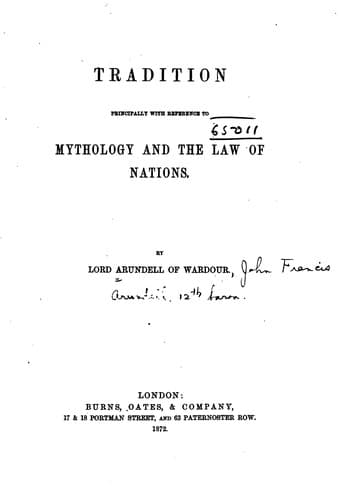
Tradition, Principally with Reference to Mythology and the Law of NationsArundell of Wardour, John Francis Arundell, Baron
Philosophy
Tradition, Principally with Reference to Mythology and the Law of Nations
Arundell of Wardour, John Francis Arundell, Baron
International law; Macdonell, George, 1780-1870; Mythology; Natural law; Tradition (Theology)
Diogenes Laertius' whole figure is 48,863 years, which contains for its
fictitious part _thirty_ times 1461 = 43,830, which, being deducted
from 48,863,
43,830
------
5,033
leaves 5033 for "true human time." Now 5033 years are equal to those
2922 years + 217 years + 1881 years, which alone in the Chronicle
belong properly and originally to the xiii gods and viii demigods and
the last xv dynasties of the kings from Menes to Nectanebo, with only
thirteen surplus years, _i.e._ from the conquest of Darius Ochus to
Alexander; "seemingly to the autumn of B.C. 332, when he first entered
Egypt."
Here I might conclude my outline of Mr Palmer's scheme, so far as is
necessary to the vindication of the Chronicle as against Bunsen, were
it not for the remaining figure (all the others, if the reader will
refer back, have been accounted for)--viz. 184, to which Bunsen refers.
This figure is shown to correspond with the 184 years of the Hyksos or
Shepherds (i. 134, 135, _et seq._, 155, 285, 299). Dynasty XXVII., to
which the 184 years in the Chronicle are attributed, has been displaced
from between Dynasties XVII. and XVIII. of the Chronicle, and its
184 years are "restored to their true place and to the Shepherds by
Manetho," and are given "by the Theban priests, _i.e._ by Eratosthenes,
suppressing the Shepherds, to the kings of Upper Egypt."
As regards Manetho (i. 284) "having, besides the 1881 years of the
Chronicle, 1674 additional years of kings, of which (22 + 217 =
) 239 only are in themselves, though not in their attributions,
chronological, and having given of these 1491 (which are thrice 477
and 60 over) to his six early dynasties of _Lower_ Egypt (and sixteen
inconvenient years he isolated between his Dynasties XIV. and XV.,
so as to include them in his Book i.), he gave to the three early
dynasties of _Upper_ Egypt _no other unchronological years_ than two
complementary sums, the one of 43 (to the first), and the other, of 124
years, to the second of the three dynasties, that these same sums might
both coalesce with the remainder of sixty years belonging to the sum of
the six dynasties of Lower Egypt, so as to make with it, or rather to
indicate, the one of them the sum of 103, the other the sum of 184."
_Vide_ table, p. 285.... Sum of six dynasties of Lower Egypt, 1491.
But this sum 1491 is equivalent to
190 + 103 + 184 = 477
190 + 103 + 184 = 477
190 + 103 + 184 = 477
---- But 60
(1431 + 60) = 1491 43
----
(1431 + 60) + 43 = 103
(43 of Dyn. XIV. of Upper Egypt.)
(1431 + 60)
124
----
184 (124 of Dyn. XV. of Upper
Egypt in Book ii.)
Public-domain text, read in full here on John Shaqi.
Reviews
Reviews
No reviews yet
Be the first to share your thoughts on this work.
Elsewhere in the archive
Join the Discussion
Join the discussion
Sign in to leave a comment or review.
Sign InorCreate an account