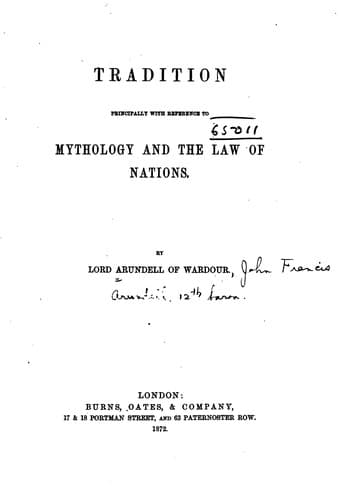
Tradition, Principally with Reference to Mythology and the Law of NationsArundell of Wardour, John Francis Arundell, Baron
Philosophy
Tradition, Principally with Reference to Mythology and the Law of Nations
Arundell of Wardour, John Francis Arundell, Baron
International law; Macdonell, George, 1780-1870; Mythology; Natural law; Tradition (Theology)
"Tradition reveals the past to us, and consequently it reveals
to us also the future. It is the tie which binds the past, the
present, and the future together, and is the science of them
all. If we possessed the memory of mankind, as we do that of our
personal existence, we should know all. But if we have not the
memory of mankind, does not mankind possess it? Is mankind without
memory, without tradition?... There is no nation which does not
exist through tradition, not only historical traditions relative to
its earthly existence, but through religious traditions relative to
its eternal destiny. To despise this treasure, what is it but to
despise life, and that which constitutes its connection, its unity,
its light, as we have just seen?... When God spoke to men His Word
passed into time ... Happily tradition seized upon it as soon as it
left the threshold of eternity; and tradition is neither an ear,
nor a mouth, nor an isolated memory, but the ear, the mouth, and
the memory of generations united together by tradition itself, and
imparting to it an existence superior to the caprices and weakness
of individuals. Nevertheless, God would not trust to oral tradition
alone ... Symbolical tradition was to add itself to oral tradition
by sustaining and confirming it ... The five terms constituting
the mystery of good and evil: the existence of God, the creation
of the world and of man by God, the fall of man, his restoration
by a great act of divine mercy, and, lastly, the final judgment
of mankind ... and that which oral tradition declared, symbolical
tradition should repeat at all times and in all places, in order
that the obscured or deceived memory of man might be brought back
again to truth by an external, a public, an universal, all-powerful
spectacle. [Lacordaire is speaking principally with reference to
sacrifice and the sacrifice of Mount Calvary.] ... Each time that
oral tradition underwent a movement of renovation by the breath of
God, symbolical tradition felt the effects of it. The sacrifice
of Abel marks the era of patriarchal tradition; the sacrifice of
Abraham marks the era of Hebrew tradition; the sacrifice of Jesus
Christ, the final and consummating sacrifice, marks the era of
Christian tradition.... Such is the nature of tradition, and such
its history. Tradition is the connection of the present with the
past, of the past with the future; it is the principle of identity
and continuity which forms persons, families, nations, and mankind.
It flows in the human race by three great streams which are clearly
perceptible--the Christian, the Hebrew, and the patriarchal or
primitive; in all these three it is oral and symbolical, and
whether as oral or symbolical it speaks of God, the creation, the
fall, reparation and judgment.... Without occupying ourselves with
the question as to whether Scripture was a gift from above or an
Public-domain text, read in full here on John Shaqi.
Reviews
Reviews
No reviews yet
Be the first to share your thoughts on this work.
Elsewhere in the archive
Join the Discussion
Join the discussion
Sign in to leave a comment or review.
Sign InorCreate an account