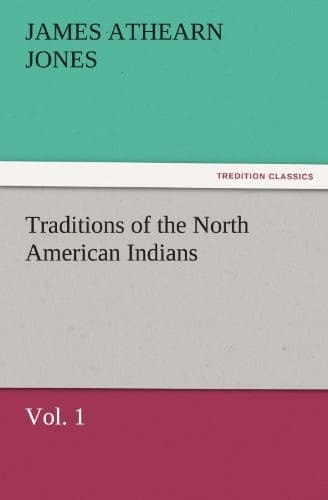
Traditions of the North American Indians, Vol. 1Jones, James Athearn
History
Traditions of the North American Indians, Vol. 1
Jones, James Athearn
Indians of North America -- Folklore
He did not leave Quebec until the return of spring, when, in the
prosecution of his object, he bade adieu to his pleasant quarters, and
travelled into the country of the Iroquois or Five Nations. His friend,
the Governor, persuaded him much to take an interpreter with him, and
nominated good old father Luke Bisset for that purpose. But M. Verdier
declined, trusting that the "coincidences of sound and signification,"
(suggested in query 2, paper B,) would free him from all difficulties on
that score. He hired an Indian, who had come to Quebec to dispose of his
furs, to act as his guide, and a French boy to carry his change of linen
and his presents, the last named being a labour to which no Indian will
submit, unless he has become an outcast from his tribe, or otherwise
disgraced and dishonoured.
They set out for the country of the Iroquois in the month of May, 1698.
After travelling for many weeks, at a great rate, for the Savages are
inconceivably swift walkers, and can endure great fatigues, they
arrived at the principal town of the Five Nations. There, and elsewhere
within the limits of that confederacy, our traveller abode two full
years. The public must not expect to find in this brief introduction a
cursory statement, much less a minute journal of his curious
observations and discoveries during that period. The Editor would make a
very bad use of the confidence reposed in him, if he were to attempt
either. Public curiosity, however, will be gratified, for the highly
learned and philosophical reports of M. Verdier on the philology,
origin, history, manners, and customs, of the Aborigines of America,
will soon be published under the eye of a competent gentleman. But, for
the immediate satisfaction of those who have had their minds highly
excited on the subject, and prefer to have their knowledge in advance,
the Editor begs leave to observe, that these reports fully prove that
the Indians of North America and the Tartars of the Eastern continent
are of a common stock. The former, M. Verdier proves, by a long train of
reasoning, to be descended from a Calmuck, who, in the year 622, (the
year of Mahomet's flight from Mecca) married a Samoyede woman, and, with
a party of his countrymen, crossed Behring's Straits to the Western
Continent. The exceedingly subtle and plausible process by which he
arrived at the exact year in which they crossed, and determined that the
emigrants were of two different tribes--again, that the chief was tall
and lean, his wife short, pursy, and thick-breathed, proved the value of
trifling circumstances to the creation of beautiful theories, and with
what wonderful ingenuity philosophic minds apply themselves to subjects
capable of being theorised. Thus, from the circumstance that the Indian
curs, when they were possessed of a bone, would snarl and show their
teeth if one went near them, and even hide it in the ground rather than
have it taken from them, he drew the conclusion that they were the true
Public-domain text, read in full here on John Shaqi.
Reviews
Reviews
No reviews yet
Be the first to share your thoughts on this work.
Join the Discussion
Join the discussion
Sign in to leave a comment or review.
Sign InorCreate an account