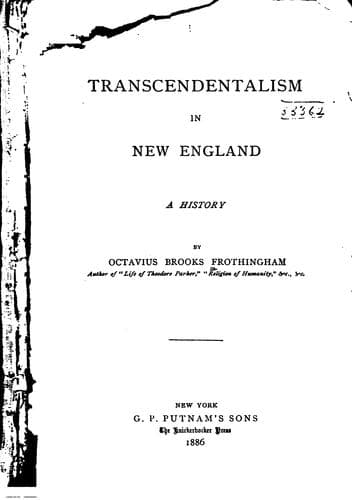
Transcendentalism in New England: A HistoryFrothingham, Octavius Brooks
Philosophy
Transcendentalism in New England: A History
Frothingham, Octavius Brooks
Transcendentalism (New England)
lacks evidence; and to prove the wonder a miracle, is beyond
achievement. A possibility, or at most, a probability of God's existence
is all that sensationalism, with every advantage given it, can supply.
And if this philosophy fails to give an assurance of God's existence,
the failure to throw light on his attributes is more signal. The senses
report things as they exist in relations, not as they exist in
themselves. Neither absolute power, absolute wisdom nor absolute
goodness is hinted at by the senses. The visible system of things
abounds in contradictions that we cannot reconcile, puzzles we cannot
explain, mysteries we cannot penetrate, imperfections we cannot account
for, wrongs we cannot palliate, evils we cannot cover up or justify.
That a vein of wisdom, an element of goodness, an infusion of
loving-kindness is in the world is evident; but to show that, is to go
very little way towards establishing the attributes of a Perfect Being.
A God of limited power, wisdom or goodness, is no God, and no other does
Sensationalism offer. Transcendentalism points to the fact that under
the auspices of this philosophy atheism has spread; and along with
atheism the intellectual demoralization that accompanies the
disappearance of a cardinal idea.
From this grave peril the Transcendentalist found an escape in flight to
the spiritual nature of man, in virtue of which he had an intuitive
knowledge of God as a being, infinite and absolute in power, wisdom and
goodness; a direct perception like that which the senses have of
material objects; a perception that gains in distinctness, clearness and
positiveness as the faculties through which it is obtained increase in
power and delicacy. To the human mind, by its original constitution,
belongs the firm assurance of God's existence, as a half latent fact of
consciousness, and with it a dim sense of his moral attributes. To minds
capacious and sensitive the truth was disclosed in lofty ranges that
lifted the horizon line, in every direction, above the cloud land of
doubt; to minds cultivated, earnest, devout, aspiring, the revelation
came in bursts of glory. The experiences of inspired men and women were
repeated. The prophet, the seer, the saint, was no longer a favored
person whose sayings and doings were recorded in the Bible, but a living
person, making manifest the wealth of soul in all human beings.
Communication with the ideal world was again opened through conscience;
and communion with God, close and tender as is anywhere described by
devotees and mystics, was promised to the religious affections.
Public-domain text, read in full here on John Shaqi.
Reviews
Reviews
No reviews yet
Be the first to share your thoughts on this work.
Elsewhere in the archive
Join the Discussion
Join the discussion
Sign in to leave a comment or review.
Sign InorCreate an account