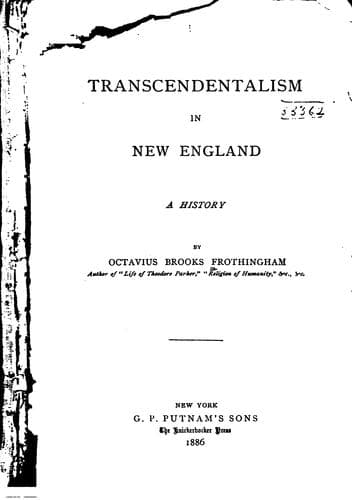
Transcendentalism in New England: A HistoryFrothingham, Octavius Brooks
Philosophy
Transcendentalism in New England: A History
Frothingham, Octavius Brooks
Transcendentalism (New England)
"It may be said these religious teachers (Zoroaster, Buddha, Fo)
pretended to work miracles. I would not deny that they _did_ work
miracles. If a man is obedient to the law of his mind, conscience
and heart, since his intellect, character and affections are in
harmony with the laws of God, I take it he can do works that are
impossible to others, who have not been so faithful, and
consequently are not "one with God" as he is; and this is all that
is meant by a miracle." "The possession of this miraculous power,
when it can be proved, as I look at the thing, is only a _sign_,
which may be uncertain, of the superior genius of a religious
teacher, or a _sign_ that he will utter the truth, and never a
_proof_ thereof."
The Transcendentalist was a cordial believer in marvels, as being so
hearty a believer in the potency of the spiritual laws. Parker's
opposition to the miracles of the New Testament was provoked by the
exclusive claim that was put forward by their defenders, and by the
position they were thrust into as pillars of doctrine. His wish to make
it appear that truth could stand without them, impelled him to strain at
their overthrow. Later, his studies in New Testament criticism confirmed
his suspicion that the testimony in their favor was altogether
inadequate to sustain their credibility. The theory of Bauer and his
disciples of the Tübingen school seemed to him unanswerable, and he
abandoned, as a scholar, much that as a Transcendentalist he might have
been disposed to retain. W. H. Furness, author of several biographical
studies on the life and character of Jesus--a Transcendentalist
of the most impassioned school, but no adept in historical
criticism--maintained to the last the credibility of the Christian
miracles, and purely on the ground of their perfect naturalness as
performed by a person so spiritually exalted as Jesus was. The more
ardent his admiration of that character, the more unshrinking his belief
in these manifestations of its superiority. Dr. Furness is prepared to
think that if no miracles had been recorded, nevertheless miracles must
have been wrought, and would, but for some blindness or skepticism, have
been mentioned.
Public-domain text, read in full here on John Shaqi.
Reviews
Reviews
No reviews yet
Be the first to share your thoughts on this work.
Elsewhere in the archive
Join the Discussion
Join the discussion
Sign in to leave a comment or review.
Sign InorCreate an account