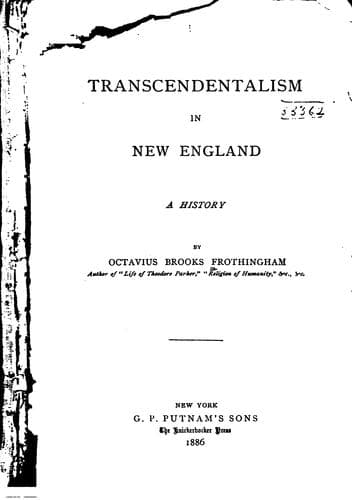
Transcendentalism in New England: A HistoryFrothingham, Octavius Brooks
Philosophy
Transcendentalism in New England: A History
Frothingham, Octavius Brooks
Transcendentalism (New England)
The charge that Transcendentalism denied the reality of supernatural
powers and influences shows how imperfectly it was apprehended. It
seemed to deny them because it transferred them to another sphere. It
regarded man himself as a supernatural being; not the last product of
nature, but the lord of nature; not the _creature_ of organization, but
its creator. In its extreme form, Transcendentalism was a deification of
nature, in the highest aspects of Beauty. It raised human qualities to
the supreme power; it ascribed to extraordinary virtue in its exalted
states the efficient grace that is commonly attributed to the Holy
Spirit. The pure Transcendentalist spoke of the experiences and powers
of the illuminated soul with as much extravagance of rapture as one of
the newly redeemed ever expressed. The profane made sport of his
fanaticisms and fervors in the same way that they made sport of the wild
over-gush of a revival meeting. The demonstrations of feeling were in
fact, precisely similar; only in the one case the excitement was traced
to the Christ in the skies, in the other to the Christ who was the soul
of the man; in the one case a superhuman being was imagined as operating
on the soul; in the other case the soul was supposed to be giving
expression to itself.
The Transcendentalist was not careful enough in making this distinction,
and was, therefore, to blame for a portion of the misapprehension that
ensued. He often found in sacred literature, thoughts which he himself
put there. Parker, discoursing of inspiration, cites Paul and John as
holding the same doctrine with himself; though it is plain to the single
mind that their doctrine was in no respect the same, but so different as
to be in contradiction. Paul and John, it is hardly too much to say, set
up their doctrine in precise opposition to the doctrine of the
Transcendentalists. Paul declared that the natural man could _not_
discern divine things; that they were foolishness to him; that they must
be spiritually discerned; that the Christian was able to discern them
spiritually _because he had_ the "mind of Christ." The eighth chapter of
the Epistle to the Romans contains sentences that, taken singly, apart
from their connection, comfort the cockles of the transcendental heart;
but the writer is glorifying Christ the inspirer; not the soul he
inspired. He opens the chapter with the affirmation that "there is no
condemnation to them which are in CHRIST JESUS, who walk not after the
flesh, but after the spirit," and follows it with the saying that "if
any man have not the _Spirit of Christ_, he is none of his." This is
the spirit that "quickens mortal bodies," that makes believers to be
"Sons of God," giving them the spirit of adoption whereby they cry
"Abba, Father," bearing witness with their spirit that they are "the
children of God." This is the spirit that "helpeth our infirmities," and
"maketh intercession with groanings which cannot be uttered."
Public-domain text, read in full here on John Shaqi.
Reviews
Reviews
No reviews yet
Be the first to share your thoughts on this work.
Elsewhere in the archive
Join the Discussion
Join the discussion
Sign in to leave a comment or review.
Sign InorCreate an account