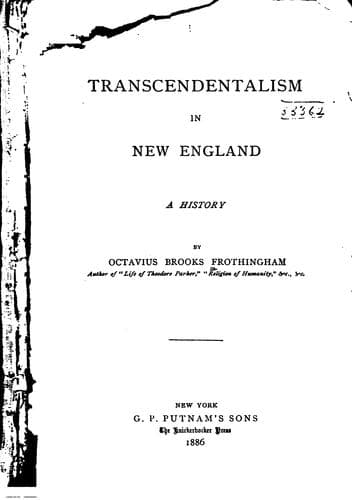
Transcendentalism in New England: A HistoryFrothingham, Octavius Brooks
Philosophy
Transcendentalism in New England: A History
Frothingham, Octavius Brooks
Transcendentalism (New England)
Transcendentalism deliberately broke with Christianity. Paul said "other
foundation can no man lay than that is laid, which is Jesus Christ."
Transcendentalism responded: "Jesus Christ built on my foundation, the
soul;" and, for thus answering, was classed with those who used as
building materials "wood, hay, stubble," which the fire would consume.
In the view of Transcendentalism, Christianity was an illustrious form
of natural religion--Jesus was a noble type of human nature; revelation
was disclosure of the soul's mystery; inspiration was the filling of the
soul's lungs; salvation was spiritual vitality.
Transcendentalism carried its appeal to metaphysics. At present physics
have the floor. Our recent studies have been in the natural history of
the soul. Its spiritual history is discredited. But the human mind ebbs
and flows. The Bains and Spencers and Taines may presently give place to
other prophets; psychology may come to the front again, and with it will
reappear the sages and seers. In that event, the religion of
Transcendentalism will revive, and will have a long and fair day.
For it can hardly be supposed that the present movement in the line of
observation is the final one; that henceforth we are to continue
straight on till, by the path of physiology, we arrive at absolute
truth; that idealism is dead and gone for ever, and materialism of a
refined type holds the future in its hand. The triumphs of the
scientific method in the natural world are wonderful. The law of
evolution has its lap full of promise. But one who has studied at all
the history of human thought; who has seen philosophies crowned and
discrowned, sceptred and outcast; who has followed the changing fortunes
of opposing schools, and witnessed the alternate victories and defeats
that threatened, each in its turn, to decide the fate of philosophy,
will be slow to believe that the final conflict has been fought, or is
to be, for hundreds of years to come. The principles of the
"Sensational" philosophy have, within the last half century, been
revived and restated with great power by Mill, Bain, Spencer, Taine, and
other leaders of speculative opinion both in England and Europe. Recent
discoveries and generalizations in physical science have lent
countenance to them. The investigations in physiology and biology, the
researches in the regions of natural history, the revelations of
chemistry, have all combined to confirm their truth. Psychology, in the
hands of its latest masters, has worked successfully in their interest.
The thinness, shallowness and dry technicality of the original school
have given place to a rich and varied exposition of the facts of organic
life in its origin, development and results. The original form of the
Sensational philosophy as it prevailed in Europe is described by Mill as
"the shallowest set of doctrines which perhaps, were ever passed off
upon a cultivated age as a complete psychological system; a system which
Public-domain text, read in full here on John Shaqi.
Reviews
Reviews
No reviews yet
Be the first to share your thoughts on this work.
Elsewhere in the archive
Join the Discussion
Join the discussion
Sign in to leave a comment or review.
Sign InorCreate an account