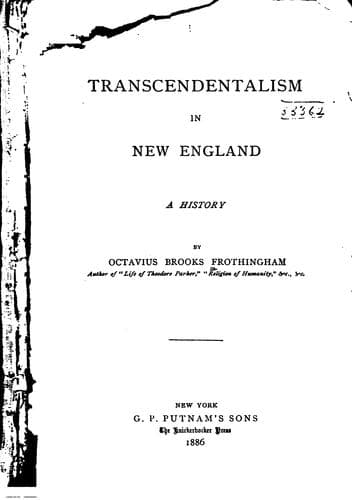
Transcendentalism in New England: A HistoryFrothingham, Octavius Brooks
Philosophy
Transcendentalism in New England: A History
Frothingham, Octavius Brooks
Transcendentalism (New England)
"He regards the world in its immediate aspect, with fresh vision;
the thing done or occurring before him opens the way to serene
heights. The living have precedence of the dead. Even the living of
to-day of the Greeks of yesterday, nobly as the latter thought,
moulded, chiselled, sang. For me was the breath of life, for me the
rapture of spring, for me love and desire, for me the secret of
wisdom and power."... "Emerson fills me with courage and
confidence. He has read and observed, but he betrays no sign of
toil. He presents familiar facts, but he places them in new lights
and combinations. From every object the lines run straight out,
connecting it with the central point of life. What I had hardly
dared to think, it was so bold, he brings forth as quietly as if it
was the most familiar commonplace. He is a perfect swimmer on the
ocean of modern existence. He dreads no tempest, for he is sure
that calm will follow it; he does not hate, contradict, or dispute,
for he understands men and loves them. I look on with wonder to see
how the hurly-burly of modern life subsides, and the elements
gently betake themselves to their allotted places. Had I found but
a single passage in his writings that was an exception to this
rule, I should begin to suspect my judgment, and should say no
further word; but long acquaintance confirms my opinion. As I think
of this man, I have understood the devotion of pupils who would
share any fate with their master, because his genius banished doubt
and imparted life to all things."
Grimm tells us that one day he found Emerson's Essays in the hands of a
lady to whom he had recommended them without effect. She had made a
thousand excuses; had declared herself quite satisfied with Goethe, who
had all that Emerson could possibly have, and a great deal more; had
expressed doubts whether, even if Emerson were all that his admirers
represented, it was worth while to make a study of him. Besides, she had
read in the book, and found only commonplace thoughts which had come to
herself, and which she considered not of sufficient importance to
express. So Emerson was neglected.
"On this occasion she made him the subject of conversation. She had
felt that he was something remarkable. She had come upon sentences,
many times, that opened the darkest recesses of thought. I listened
quietly, but made no response. Not long afterwards she poured out
to me her astonished admiration in such earnest and impassioned
strain, that she made me feel as if I was the novice and she the
apostle."
Public-domain text, read in full here on John Shaqi.
Reviews
Reviews
No reviews yet
Be the first to share your thoughts on this work.
Elsewhere in the archive
Join the Discussion
Join the discussion
Sign in to leave a comment or review.
Sign InorCreate an account