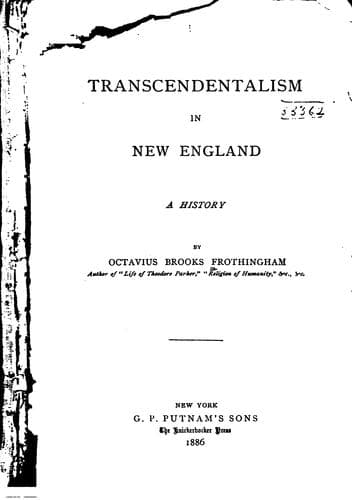
Transcendentalism in New England: A HistoryFrothingham, Octavius Brooks
Philosophy
Transcendentalism in New England: A History
Frothingham, Octavius Brooks
Transcendentalism (New England)
This experience was repeated again and again, and Grimm had the
satisfaction of seeing the indifferent kindle, the adverse turn, the
objectors yield. The praise was not universal indeed; there were
stubborn dissentients who did not confess the charm, and declared that
the enthusiasm was infatuation. Such remained unconverted. It was
discovered that Emerson came to his own only, though his own were a
large and increasing company.
The reasons of Grimm's admiration have been sufficiently indicated in
the above extracts. They are good reasons, but they are not the best.
They do not touch the deeper secret of power. That secret lies in the
writer's pure and perfect idealism, in his absolute and perpetual faith
in thoughts, his supreme confidence in the spiritual laws. He lives in
the region of serene ideas; lives there all the day and all the year;
not visiting the mount of vision occasionally, but setting up his
tabernacle there, and passing the night among the stars that he may be
up and dressed for the eternal sunrise. To such a spirit there is no
night: "the darkness shineth as the day; the darkness and the light are
both alike." There are no cloudy days. Tyndall's expression "in his case
Poetry, with the joy of a bacchanal, takes her graver brother science by
the hand, and cheers him with immortal laughter"--is singularly
infelicitous in phrase, for it is as easy to associate night orgies with
the dawn as the bacchanalian spirit with Emerson, who never riots and
never laughs, but is radiant with a placid buoyancy that diffuses itself
over his countenance and person. Mr. Emerson's characteristic trait is
serenity. He is faithful to his own counsel, "Shun the negative side.
Never wrong people with your contritions, nor with dismal views of
politics or society. Never name sickness; even if you could trust
yourself on that perilous topic, beware of unmuzzling a valetudinarian
who will soon give you your fill of it." He seems to be perpetually
saying "Good Morning."
This is not wholly a result of philosophy; it is rather a gift of
nature. He is the descendant of eight generations of Puritan
clergymen,--the inheritor of their thoughtfulness and contemplation,
their spirit of inward and outward communion. The dogmatism fell away;
the peaceful fruits of discipline remained, and flowered beautifully in
his richly favored spirit. An elder brother William, whom it was a
privilege to know, though lacking the genius of Waldo, was a natural
idealist and wise saint. Charles, another brother, who died young and
greatly lamented had the saintliness and the genius both. The "Dial"
contained contributions from this young man, entitled "Notes from the
Journal of a Scholar" that strongly suggest the genius of his eminent
brother; a few passages from them may be interesting as throwing light
on the secret of Emerson's inspiration.
Public-domain text, read in full here on John Shaqi.
Reviews
Reviews
No reviews yet
Be the first to share your thoughts on this work.
Elsewhere in the archive
Join the Discussion
Join the discussion
Sign in to leave a comment or review.
Sign InorCreate an account