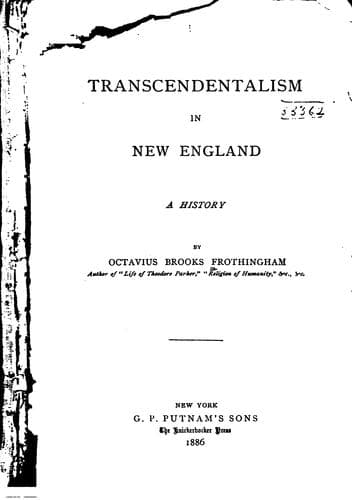
Transcendentalism in New England: A HistoryFrothingham, Octavius Brooks
Philosophy
Transcendentalism in New England: A History
Frothingham, Octavius Brooks
Transcendentalism (New England)
"This afternoon we read Shakspeare. The verse so sank into me, that
as I toiled my way home under the cloud of night, with the gusty
music of the storm around and overhead, I doubted that it was all
a remembered scene; that humanity was indeed one, a spirit
continually reproduced, accomplishing a vast orbit, whilst
individual men are but the points through which it passes.
We each of us furnish to the angel who stands in the sun, a single
observation. The reason why Homer is to me like dewy morning, is
because I too lived while Troy was, and sailed in the hollow ships
of the Grecians to sack the devoted town. The rosy-fingered dawn as
it crimsoned the tops of Ida, the broad sea shore covered with
tents, the Trojan hosts in their painted armor, and the rushing
chariots of Diomed and Idomeneus,--all these I too saw: my ghost
animated the frame of some nameless Argive; and Shakspeare, in King
John, does but recall to me myself in the dress of another age, the
sport of new accidents. I who am Charles, was sometime Romeo. In
Hamlet I pondered and doubted. We forget what we have been, drugged
by the sleepy bowl of the Present. But when a lively chord in the
soul is struck, when the windows for a moment are unbarred, the
long and varied past is recovered. We recognize it all; we are no
more brief, ignoble creatures; we seize our immortality and bind
together the related parts of our secular being."
From the second record of thoughts a passage may be taken, so precisely
like paragraphs in the essays that they might have proceeded from the
same mind:
"Let us not vail our bonnets to circumstance. If we act so, because
we are so; if we sin from strong bias of temper and constitution,
at least we have in ourselves the measure and the curb of our
aberration. But if they who are around us sway us; if we think
ourselves incapable of resisting the cords by which fathers and
mothers and a host of unsuitable expectations and duties, falsely
so called, seek to bind us,--into what helpless discord shall we
not fall."
"I hate whatever is imitative in states of mind as well as in
action. The moment I say to myself, 'I ought to feel thus and so,'
life loses its sweetness, the soul her vigor and truth. I can only
recover my genuine self by stopping short, refraining from every
effort to shape my thought after a form, and giving it boundless
freedom and horizon. Then, after oscillation more or less
protracted, as the mind has been more or less forcibly pushed from
its place, I fall again into my orbit and recognize myself, and
find with gratitude that something there is in the spirit which
changes not, neither is weary, but ever returns into itself, and
partakes of the eternity of God."
Public-domain text, read in full here on John Shaqi.
Reviews
Reviews
No reviews yet
Be the first to share your thoughts on this work.
Elsewhere in the archive
Join the Discussion
Join the discussion
Sign in to leave a comment or review.
Sign InorCreate an account