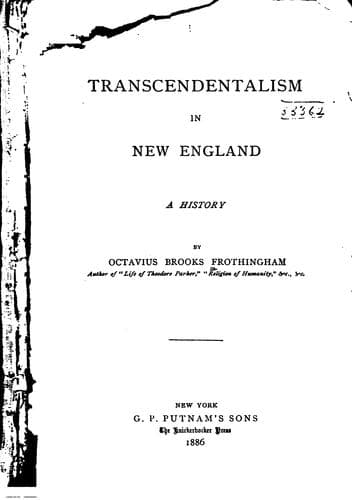
Transcendentalism in New England: A HistoryFrothingham, Octavius Brooks
Philosophy
Transcendentalism in New England: A History
Frothingham, Octavius Brooks
Transcendentalism (New England)
Idealism is native to this temperament, the proper expression of its
feeling. Emerson was preordained an idealist; he is one of the eternal
men, bearing about him the atmosphere of immortal youth. He is now
seventy-three years old, having been born in Boston May 25th, 1803; but
his last volume, "Letters and Social Aims," shows the freshness of his
first essays. The opening chapter, "Poetry and Imagination," has the
emphasis and soaring confidence of undimmed years; and the closing one,
"Immortality," sustains an unwearied flight among the agitations of this
most hotly-debated of beliefs. The address before the Phi Beta Kappa
Society at Cambridge, in 1867, equals in moral grandeur and earnestness
of appeal, in faithfulness to ideas and trust in principles, the
addresses that made so famous the prime of his career. There is
absolutely no abatement of heart or hope; if anything, the tone is
richer and more assured than ever it was. During the season of his
popularity as a lyceum lecturer, the necessity of making his discourse
attractive and entertaining, brought into the foreground the play of his
wit, and forced the graver qualities of his mind into partial
concealment; but in later years, in the solitude of his study, the
undertone of high purpose is heard again, in solemn reverberations,
reminding us that the unseen realities are present still; that no
opening into the eternal has ever been closed.
"Shall we study the mathematics of the sphere," he says to the
Cambridge scholars, "and not its causal essence also? Nature is a
fable, whose moral blazes through it. There is no use in
Copernicus, if the robust periodicity of the solar system does not
show its equal perfection in the mental sphere--the periodicity,
the compensating errors, the grand reactions. I shall never believe
that centrifugence and centripetence balance, unless mind heats and
meliorates, as well as the surface and soil of the globe."
"On this power, this all-dissolving unity, the emphasis of heaven
and earth is laid. Nature is brute, but as this soul quickens it;
nature always the effect, mind the flowing cause. Mind carries the
law; history is the slow and atomic unfolding."
"All vigor is contagious, and when we see creation, we also begin
to create. Depth of character, height of genius, can only find
nourishment in this soil. The miracles of genius always rest on
profound convictions which refuse to be analyzed. Enthusiasm is the
leaping lightning, not to be measured by the horse-power of the
understanding. Hope never spreads her golden wings but on
unfathomable seas."
Public-domain text, read in full here on John Shaqi.
Reviews
Reviews
No reviews yet
Be the first to share your thoughts on this work.
Elsewhere in the archive
Join the Discussion
Join the discussion
Sign in to leave a comment or review.
Sign InorCreate an account