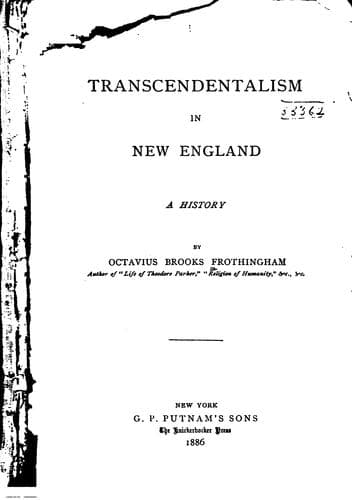
Transcendentalism in New England: A HistoryFrothingham, Octavius Brooks
Philosophy
Transcendentalism in New England: A History
Frothingham, Octavius Brooks
Transcendentalism (New England)
"We wish to put the ideal rules into practice, to offer liberty
instead of chains, and see whether liberty will not disclose its
proper checks; believing that a free press will prove safer than
the censorship; to ordain free trade, and believe that it will not
bankrupt us; universal suffrage, believing that it will not carry
us to mobs or back to kings again."
"Every inch of the mountains is scarred by unimaginable
convulsions, yet the new day is purple with the bloom of youth and
love. Look out into the July night, and see the broad belt of
silver flame which flashes up the half of heaven, fresh and
delicate as the bonfires of the meadow flies. Yet the powers of
numbers cannot compute its enormous age--lasting as time and
space--embosomed in time and space. And time and space, what are
they? Our first problems, which we ponder all our lives through,
and leave where we found them; whose outrunning immensity, the old
Greeks believed, astonished the gods themselves; of whose dizzy
vastitudes, all the worlds of God are a mere dot on the margin;
impossible to deny, impossible to believe. Yet the moral element in
man counterpoises this dismaying immensity and bereaves it of
terror."
Emerson has been called the prince of Transcendentalists. It is nearer
the truth to call him the prince of idealists. A Transcendentalist, in
the technical sense of the term, it cannot be clearly affirmed that he
was. Certainly he cannot be reckoned a disciple of Kant, or Jacobi, or
Fichte, or Schelling. He calls no man master; he receives no teaching on
authority. It is not certain that he ever made a study of the
Transcendental philosophy in the works of its chief exposition. In his
lecture on "The Transcendentalist," delivered in 1842, he conveys the
impression that it is idealism--active and protesting--an excited
reaction against formalism, tradition, and conventionalism in every
sphere. As such, he describes it with great vividness and beauty. But as
such merely, it was not apprehended by metaphysicians like James Walker,
theologians like Parker or preachers like William Henry Channing.
Public-domain text, read in full here on John Shaqi.
Reviews
Reviews
No reviews yet
Be the first to share your thoughts on this work.
Elsewhere in the archive
Join the Discussion
Join the discussion
Sign in to leave a comment or review.
Sign InorCreate an account