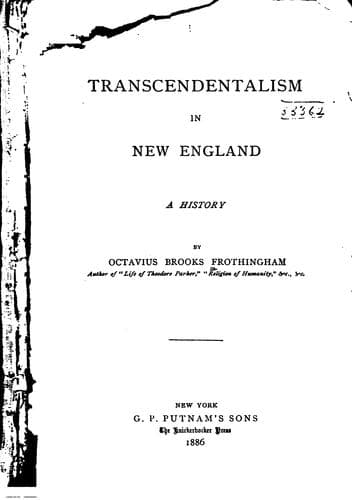
Transcendentalism in New England: A HistoryFrothingham, Octavius Brooks
Philosophy
Transcendentalism in New England: A History
Frothingham, Octavius Brooks
Transcendentalism (New England)
Emerson does not claim for the soul a special faculty, like faith or
intuition, by which truths of the spiritual order are perceived, as
objects are perceived by the senses. He contends for no doctrines,
whether of God or the hereafter, or the moral law, on the credit of such
interior revelation. He neither dogmatizes nor defines. On the contrary,
his chief anxiety seems to be to avoid committing himself to opinions;
to keep all questions open; to close no avenue in any direction to the
free ingress and egress of the mind. He gives no description of God that
will class him as theist or pantheist; no definition of immortality that
justifies his readers in imputing to him any form of the popular belief
in regard to it. Does he believe in personal immortality? It is
impertinent to ask. He will not be questioned; not because he doubts,
but because his beliefs are so rich, various and many-sided, that he is
unwilling, by laying emphasis on any one, to do an apparent injustice to
others. He will be held to no definitions; he will be reduced to no
final statements. The mind must have free range. Critics complain of the
tantalizing fragmentariness of his writing; it is evidence of the
shyness and modesty of his mind. He dwells in principles, and will not
be cabined in beliefs. He needs the full expanse of the Eternal Reason.
In the chapter on Worship--"Conduct of Life," p. 288, he writes thus:
"Of immortality, the soul, when well employed, is incurious; it is
so well, that it is sure it will be well; it asks no questions of
the Supreme Power; 'tis a higher thing to confide, that if it is
best we should live, we shall live--it is higher to have this
conviction than to have the lease of indefinite centuries, and
millenniums and æons. Higher than the question of our duration, is
the question of our deserving. Immortality will come to such as are
fit for it, and he who would be a great soul in future, must be a
great soul now. It is a doctrine too great to rest on any legend,
that is, on any man's experience but our own. It must be proved, if
at all, from our own activity and designs, which imply an
interminable future for their play."
The discourse on Immortality, which closes the volume, "Letters and
Social Aims," moves on with steady power, towards the conclusion of
belief. Emerson really seems about to commit himself; he argues and
affirms, with extraordinary positiveness. Of skepticism, on the subject,
he says:
"I admit that you shall find a good deal of skepticism in the
streets and hotels, and places of coarse amusement. But that is
only to say that the practical faculties are faster developed than
the spiritual. Where there is depravity there is a slaughter-house
style of thinking. One argument of future life is the recoil of the
mind in such company--our pain at every skeptical statement."
Public-domain text, read in full here on John Shaqi.
Reviews
Reviews
No reviews yet
Be the first to share your thoughts on this work.
Elsewhere in the archive
Join the Discussion
Join the discussion
Sign in to leave a comment or review.
Sign InorCreate an account