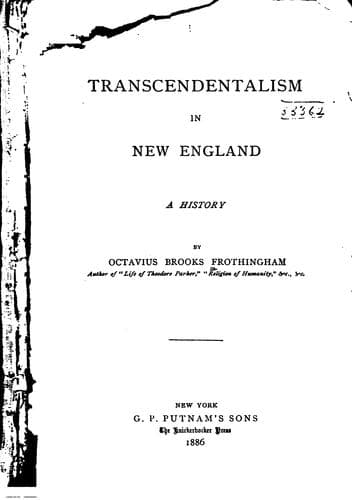
Transcendentalism in New England: A HistoryFrothingham, Octavius Brooks
Philosophy
Transcendentalism in New England: A History
Frothingham, Octavius Brooks
Transcendentalism (New England)
His enumeration of "the few simple elements of the natural faith," is as
clear and cogent as was ever made. He urges the delight in permanence
and stability, in immense spaces and reaches of time. "Every thing is
prospective, and man is to live hereafter." He urges that:
"The implanting of a desire indicates that the gratification of
that desire is in the constitution of the creature that feels it;
the wish for food; the wish for motion; the wish for sleep, for
society, for knowledge, are not random whims, but grounded in the
structure of the creature, and meant to be satisfied by food; by
motion; by sleep; by society; by knowledge. If there is the desire
to live, and in larger sphere, with more knowledge and power, it is
because life and knowledge and power are good for us, and we are
the natural depositaries of these gifts."
He ranks as a hint of endless being the novelty which perpetually
attends life:
"The soul does not age with the body." "Every really able man, in
whatever direction he work--a man of large affairs--an inventor, a
statesman, an orator, a poet, a painter--if you talk sincerely with
him, considers his work, however much admired, as far short of what
it should be. What is this 'Better,' this flying ideal but the
perpetual promise of his Creator?"
The prophecy of the intellect is enunciated in stirring tones:
"All our intellectual action, not promises but bestows a feeling of
absolute existence. We are taken out of time, and breathe a purer
air. I know not whence we draw the assurance of prolonged life: of
a life which shoots that gulf we call death, and takes hold of what
is real and abiding, by so many claims as from our intellectual
history." "As soon as thought is exercised, this belief is
inevitable; as soon as virtue glows, this belief confirms itself.
It is a kind of summary or completion of man."
This reads very much like encouragement to the popular persuasion, yet
it comes far short of it; indeed, does not, at any point touch it. The
immortality is claimed for the moral and spiritual by whom thought is
exercised, in whom virtue glows--for none beside--and for these, the
individual conscious existence is not asserted. In the midst of the high
argument occur sentences like these:
Public-domain text, read in full here on John Shaqi.
Reviews
Reviews
No reviews yet
Be the first to share your thoughts on this work.
Elsewhere in the archive
Join the Discussion
Join the discussion
Sign in to leave a comment or review.
Sign InorCreate an account