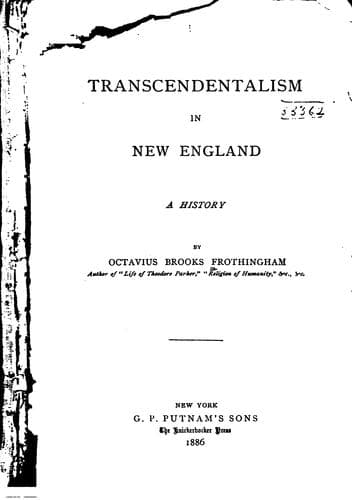
Transcendentalism in New England: A HistoryFrothingham, Octavius Brooks
Philosophy
Transcendentalism in New England: A History
Frothingham, Octavius Brooks
Transcendentalism (New England)
"Science," he says, "was false by being unpoetical. It assumed to
explain a reptile or mollusk, and isolated it,--which is hunting
for life in graveyards; reptile or mollusk, or man or angel, only
exists in system, in relation. The metaphysician, the poet, only
sees each animal form as an inevitable step in the path of the
creating mind." "The savans are chatty and vain; but hold them hard
to principle and definition, and they become mute and near-sighted.
What is motion? What is beauty? What is matter? What is life? What
is force? Push them hard and they will not be loquacious. They will
come to Plato, Proclus and Swedenborg. The invisible and
imponderable is the sole fact." "The atomic theory is only an
interior process _produced_, as geometers say, or the effect of a
foregone metaphysical theory. Swedenborg saw gravity to be only an
external of the irresistible attractions of affection and faith.
Mountains and oceans we think we understand. Yes, so long as they
are contented to be such, and are safe with the geologist; but when
they are melted in Promethean alembics and come out men; and then
melted again, come out woods, without any abatement, but with an
exaltation of power!"
Emerson is faithful in applying his principle to social institutions and
laws. His faith in ideal justice and love never blenches. In every
emergency, political, civil, national, he has been true to his
regenerating idea; true as a recreator from the inside, rather than as a
reformer of the outside world. A profounder, more consistent, more
uncompromising radical does not exist; a less heated, ruffled or anxious
one cannot be thought of. He scarcely ever suggested measures, rarely
joined in public assemblies, did not feel at home among politicians or
agitators. But his thought never swerved from the line of perfect
rectitude, his sympathies were always human. His heart was in the
anti-slavery movement from the beginning. He was abroad in its stormy
days, his steadfast bearing and cheerful countenance carrying hope
whenever he appeared. His name stood with that of his wife in the list
of signers to the call for the first National Woman's Rights Convention,
in 1850. The Massachusetts Historical Society, the American Society of
Arts and Sciences have honored themselves by electing him a member; the
Alumni of Harvard University joyfully made him an overseer; he was
proposed as rector of the University of Glasgow. Such confidence did the
great idealist inspire, that he has been even called to the duty of
Examiner at West Point Military Academy. His name is spoken in no
company with other than respect, and his influence is felt in places
where it is not acknowledged, and would be officially disavowed.
Mr. A. B. Alcott, a townsman of Mr. Emerson, and a close acquaintance,
in his "Concord Days" says pleasant things of his friend, just and
discerning things, as well as pleasant.
Public-domain text, read in full here on John Shaqi.
Reviews
Reviews
No reviews yet
Be the first to share your thoughts on this work.
Elsewhere in the archive
Join the Discussion
Join the discussion
Sign in to leave a comment or review.
Sign InorCreate an account