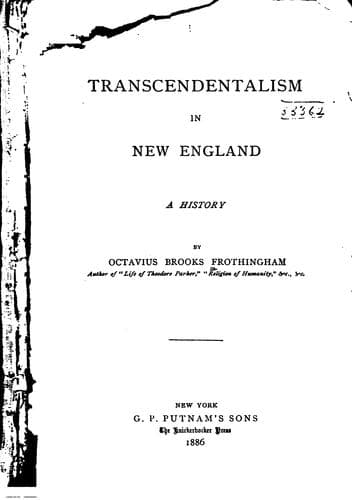
Transcendentalism in New England: A HistoryFrothingham, Octavius Brooks
Philosophy
Transcendentalism in New England: A History
Frothingham, Octavius Brooks
Transcendentalism (New England)
The chief peculiarity of the Cheshire School was the effort made there
to rouse and elevate individual minds. Single desks were substituted for
the long forms in common use; blackboards were introduced, and slates
which put the pupils on their mettle; a library was instituted of
carefully selected books, the reading whereof was diligently supervised
and directed; hopes were appealed to instead of fears; gentleness took
the place of severity; the affections and moral sentiments were
addressed, to give full action to the heart and conscience, the physical
being replaced by the spiritual scourge; light gymnastic exercises were
introduced; evening entertainments gladdened the school room after
working hours; even the youngest scholars were encouraged to clear their
minds by keeping diaries. In these and other ways, especially by the
enthusiasm and dignity of the master, knowledge was made attractive, and
the teacher's office was made venerable.
The plan, albeit nearly the same with that practised by Pestalozzi in
Switzerland, was original with Mr. Alcott, the product of his peculiar
philosophical ideas. Had those ideas been less deep and lofty, the
method might have commended itself to all as it did to Mr. May; but, had
they been less deep and lofty, it would not have been tried at all. A
profound faith in the soul suggested it, and certainly a profound faith
was required to sustain it. But faith in the soul was no more popular
then than it is now, implying, as it did, radical convictions on all
sorts of questions, and familiar assumption of the truth of the
opinions. Such a teacher is not permitted to be conventional. Mr. Alcott
showed himself the disciple of Pythagoras in that he was the worshipper
of ideal truth and purity, the uncompromising servant of the spiritual
laws. When this was fairly understood, as it was in two years, the
experiment was terminated.
The idea, which made the teacher suspected by the school committee
boards, was recognized and applauded by the finest spirits in New
England, New York and Pennsylvania. The reformers hailed the reformer;
the spiritualists welcomed the spiritualist. In Hartford, Drs. Gallaudet
and Barnard; in Boston, Dr. Channing and Mr. Garrison, the Mays,
Quincys, Phillipses, and other families of character and courage; in
Philadelphia, Dr. Furness, Matthew Cary, Robert Vaux, and the radical
Friends took him up. Mr. Emerson saluted him with high expectation, in
the words addressed by Burke to John Howard:
"Your plan is original, and as full of genius as of humanity; so do
not let it sleep or stop a day."
Public-domain text, read in full here on John Shaqi.
Reviews
Reviews
No reviews yet
Be the first to share your thoughts on this work.
Elsewhere in the archive
Join the Discussion
Join the discussion
Sign in to leave a comment or review.
Sign InorCreate an account