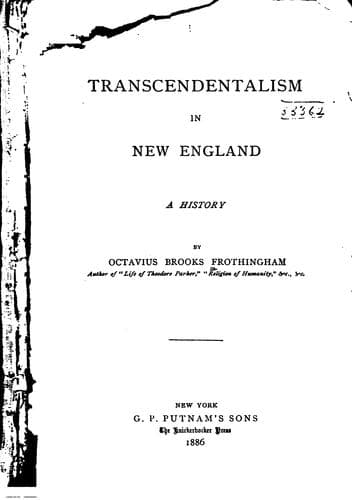
Transcendentalism in New England: A HistoryFrothingham, Octavius Brooks
Philosophy
Transcendentalism in New England: A History
Frothingham, Octavius Brooks
Transcendentalism (New England)
In 1842, Mr. Alcott visited England with the aim to confer with the
philanthropists and educators there, to exchange views, collect
information, and gather hints on the subject of literary and social
methods. Mr. Greaves was dead; but the living friends of the "First
Philosophy" received him with hearty respect and joy, introduced him to
men of literary and philanthropic eminence, and made his arrival the
occasion of meetings for conversation on the religious, social and
ethical questions of the day. The meetings were held mostly at an
institution managed on his own methods and called by his own name, the
school of Mr. Wright at Alcott House, Ham, Surrey. Strange people were
some of those he met, Communists, Alists (deriving their name from
Alah--the Hebrew name for God), Syncretic Associationists,
Pestalozzians, friends and advocates of self-supporting institutions,
experimental Normal Schools, Hydropathic and Philosophical Associations,
Health Unions, Philansteries, Utopias of every description, new social
arrangements between the sexes, new devices for making marriage what it
should be.
The London _Morning Chronicle_, of July 5th, contained the following
advertisement:
"Public Invitation.--An open meeting of the friends to human
progress will be held to-morrow, July 6th, at Mr. Wright's, Alcott
House School, Ham Common, near Richmond, Surrey, for the purpose of
considering and adopting means for the promotion of the great end,
when all who are interested in human destiny are earnestly urged to
attend. The chair taken at three o'clock, and again at seven, by A.
Bronson Alcott, Esq., now on a visit from America. Omnibuses travel
to and fro, and the Richmond steamboat reaches at a convenient
hour."
The call brought together some sixteen or twenty persons, from various
distances; one a hundred miles; another a hundred and fifty. "We did not
find it easy to propose a question sufficiently comprehensive to unfold
the whole of the fact with which our bosoms labored," writes a private
correspondent of the "Dial."
"We aimed at nothing less than to speak of the instauration of
spirit, and its incarnation in a beautiful form. When a word failed
in extent of meaning, we loaded the word with new meaning. The word
did not confine our experience, but from our own being we gave
significance to the word. Into one body we infused many lives, and
it shone as the image of divine or angelic, or human thought. For a
word is a Proteus, that means to a man what the man is."
Public-domain text, read in full here on John Shaqi.
Reviews
Reviews
No reviews yet
Be the first to share your thoughts on this work.
Elsewhere in the archive
Join the Discussion
Join the discussion
Sign in to leave a comment or review.
Sign InorCreate an account