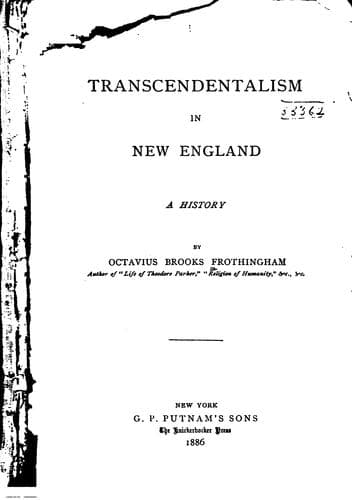
Transcendentalism in New England: A HistoryFrothingham, Octavius Brooks
Philosophy
Transcendentalism in New England: A History
Frothingham, Octavius Brooks
Transcendentalism (New England)
The "Dial" of October, 1842, prints an abstract of the proceedings,
which are interesting, as illustrations of the phases that the Spiritual
Philosophy assumed, but would occupy more space here than their
significance warrants. Three papers were presented, on Formation,
Transition, Reformation. The views, it is needless to say, were of the
extreme school. The essayist on the first theme advanced the doctrine
that evil commenced in birth; that the unpardonable sin was an unholy
birth; that birth "must be surrendered to the spirit." The second
essayist maintained that property was held on the tenure of might and
immemorial custom; that "pure love, which is ever communicative, never
yet conceded to any being the right of appropriation." "We ignore human
governments, creeds and institutions; we deny the right of any man to
dictate laws for our regulation, or duties for our performance; and
declare our allegiance only to Universal Love, the all-embracing
Justice."
The reader of the paper on Reformation pursued the same train of
thought; he demanded amendment of monetary arrangements, the penal code,
education, the church, the law of primogeniture, and divorce; challenged
reliance on commercial prosperity and popular representation; denied the
right of man to inflict pain on man; asserted that the question of
generation preceded that of education; that the reign of love was
supreme over that of opinion; insisted on "the restoration of all things
to their primitive Owner, and hence the abrogation of property--either
individual or collective;" and on "the divine sanction, instead of the
civil and ecclesiastical authority, for marriage." It was his idea, that
"aspirations are the pledge of their own fulfilment,"--that "beneath the
actual which a man is, there is always covered a possible to tempt him
forward"--that "beneath sense lie reason and understanding; beneath them
both, humility; and beneath all, God"--that "to be God-like we must pass
through the grades of progress." "Even now the God-life is enfolded in
us; even now the streams of eternity course freely in our central heart;
if impelled by the spirit to intermingle with the arrangements of
polities of the world, in order to improve them, we shall discover the
high point from which we begin, by the God-thought in our interference;
our act must be divine; we seem to do, God does; God empowers
legislators, and ennobles them for their fidelity; let them, however,
be apostles, not apostles' representatives; men of God, not men of men;
personal elevation is our credentials; personal reform is that which is
practicable, and without it our efforts on behalf of others are dreams
only."
No remarks from Mr. Alcott are recorded. That the meetings satisfied and
cheered him may be inferred from the circumstance that, immediately
after his return from England, he undertook to inaugurate the ideal
social state at Fruitlands--with what success we know.
Public-domain text, read in full here on John Shaqi.
Reviews
Reviews
No reviews yet
Be the first to share your thoughts on this work.
Elsewhere in the archive
Join the Discussion
Join the discussion
Sign in to leave a comment or review.
Sign InorCreate an account