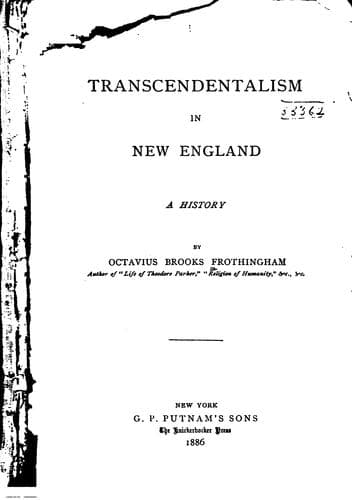
Transcendentalism in New England: A HistoryFrothingham, Octavius Brooks
Philosophy
Transcendentalism in New England: A History
Frothingham, Octavius Brooks
Transcendentalism (New England)
In 1859, Mr. Alcott had another and larger opportunity to exercise his
wisdom as an educator of youth. He was chosen superintendent of the
schools of Concord; a position that called out the finest qualities of
his mind, and put to immediate use the results of his long experience,
but relieved him from the business arrangements for which he had never
displayed an aptitude. The three brief but remarkable reports that he
made on the condition and needs of the schools, increase one's respect
for the workings of the spiritual philosophy in this field of effort. If
the suggestions offered in those reports were to any considerable extent
adopted, if the noble and gracious spirit of them was felt, the schools
of Concord should be model schools of their class.
"The school is the primary interest of the community. Every parent
naturally desires a better education for his children than he
received himself, and spends liberally of his substance for this
pleasure; wisely hoping to make up his deficiencies in that way,
and to complement himself in their better attainments; esteeming
these the richest estate he can leave, and the fairest ornaments of
his family name."
"Especially have I wished to introduce the young to the study of
their minds, the love of thinking; often giving examples of lessons
in analysis and classification of their faculties. I think I may
say that these exercises have given much pleasure, and have been
found profitable alike to the teacher and the children. In most
instances, I have closed my visits by reading some interesting
story or parable. These have never failed of gaining attention, and
in most cases, prompt responses. I consider these readings and
colloquies as among the most profitable and instructive of the
superintendent's labors."
Pilgrim's Progress, Krummacher's Parables, Æsop's Fables, Faery Queen,
the stories of Plutarch and Shakspeare, were his favorites.
"The graceful exercise of singing has been introduced into some of
the schools. It should prevail in all of them. It softens the
manners, cultivates the voice, and purifies the taste of the
children. It promotes harmony and good feelings. The old masters
thought much of it as a discipline. 'Let us sing' has the welcome
sound of 'Let us play,'--and is perhaps the child's prettiest
translation of 'Let us pray,'--admitting him soonest to the
intimacy he seeks."
"Conversations on words, paraphrases and translations of sentences,
are the natural methods of opening the study of language. A child
should never be suffered to lose sight of the prime fact that he is
studying the realities of nature and of the mind through the
picture books of language. Any teaching falling short of this is
hollow and a wrong done to the mind."
Public-domain text, read in full here on John Shaqi.
Reviews
Reviews
No reviews yet
Be the first to share your thoughts on this work.
Elsewhere in the archive
Join the Discussion
Join the discussion
Sign in to leave a comment or review.
Sign InorCreate an account