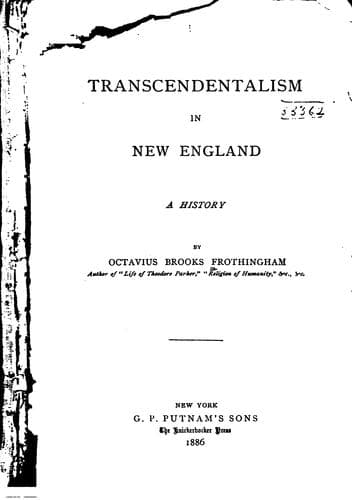
Transcendentalism in New England: A HistoryFrothingham, Octavius Brooks
Philosophy
Transcendentalism in New England: A History
Frothingham, Octavius Brooks
Transcendentalism (New England)
Margaret Fuller--she was called Ossoli long after the time
we are concerned with, in a foreign land and amid foreign
associations--Margaret Fuller died July 16th, 1850. In 1852 her Memoirs
were published in Boston, written by Ralph Waldo Emerson, James Freeman
Clarke, and William Henry Channing: each giving an individual and
personal account of her. These three gentlemen--all remarkable for
intellectual capacity, sympathetic appreciation, and literary
skill--undertook their task in the spirit of loving admiration, and
executed it with extraordinary frankness, courage and delicacy. No more
unique or satisfactory book of biography was ever made. They had known
Margaret personally and well; were intimately acquainted with her mind,
and deeply interested in her character. They had access to all the
necessary materials. The whole life--inward and outward--was open to
them, and they described it with no more reserve than good taste
imposed. Those who are interested to know what sort of a person she was,
are referred to that book, from which the biographical materials for
this little sketch have, in the main, been taken. Her place here is due
to her association with the leaders of the Transcendental movement, and
to the peculiar part she played in it.
Strictly speaking, she was not a Transcendentalist, though Mr. Channing
declares her to have been "in spirit and thought pre-eminently a
transcendentalist;" and Mr. Alcott wrote that she adopted "the spiritual
philosophy, and had the subtlest perception of its bearings." She was
enthusiastic rather than philosophical, and poetic more than systematic.
Emerson's judgment is that--
"Left to herself, and in her correspondence, she was much the
victim of Lord Bacon's _idols of the cave_, or self-deceived by her
own phantasms.... Her letters are tainted with a mysticism which,
to me, appears so much an affair of constitution, that it claims no
more respect than the charity or patriotism of a man who has dined
well and feels better for it. In our noble Margaret, her personal
feeling colors all her judgment of persons, of books, of pictures,
and even of the laws of the world.... Whole sheets of warm, florid
writing are here, in which the eye is caught by 'sapphire,'
'heliotrope,' 'dragon,' 'aloes,' 'Magna Dea,' 'limboes,' 'stars,'
and 'purgatory'--but one can connect all this or any part of it
with no universal experience.
"In short, Margaret often loses herself in sentimentalism; that
dangerous vertigo nature, in her case, adopted, and was to make
respectable.... Her integrity was perfect, and she was led and
followed by love; and was really bent on truth, but too indulgent
to the meteors of her fancy."
She said of herself:
Public-domain text, read in full here on John Shaqi.
Reviews
Reviews
No reviews yet
Be the first to share your thoughts on this work.
Elsewhere in the archive
Join the Discussion
Join the discussion
Sign in to leave a comment or review.
Sign InorCreate an account