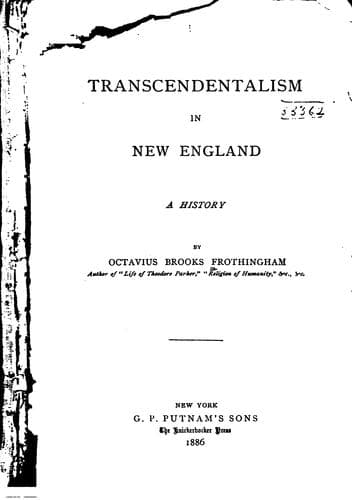
Transcendentalism in New England: A HistoryFrothingham, Octavius Brooks
Philosophy
Transcendentalism in New England: A History
Frothingham, Octavius Brooks
Transcendentalism (New England)
"One thing only she demanded of all her friends--that they should
have some 'extraordinary generous seeking;' that they should not be
satisfied with the common routine of life--that they should aspire
to something higher, better, holier, than they had now attained.
Where this element of aspiration existed, she demanded no
originality of intellect, no greatness of soul. If these were
found, well; but she could love, tenderly and truly, where they
were not.
"She never formed a friendship until she had seen and known this
germ of good, and afterwards judged conduct by this. To this germ
of good, to this highest law of each individual, she held them
true.
"Some of her friends were young, gay, and beautiful; some old,
sick, or studious; some were children of the world, others pale
scholars; some were witty, others slightly dull; but all, in order
to be Margaret's friends, must be capable of seeking
something--capable of some aspiration for the better. And how did
she glorify life to all! All that was tame and common vanishing
away in the picturesque light thrown over the most familiar things
by her rapid fancy, her brilliant wit, her sharp insight, her
creative imagination, by the inexhaustible resources of her
knowledge, and the copious rhetoric, which found words and images
always apt and always ready."
"Margaret saw in each of her friends the secret interior
capability, which might be hereafter developed into some special
beauty or power. By means of this penetrating, this prophetic
insight, she gave each to himself, acted on each to draw out his
best nature; gave him an ideal, out of which he could draw strength
and liberty, hour by hour. Thus her influence was ever ennobling,
and each felt that in her society he was truer, wiser, better, and
yet more free and happy than elsewhere. The 'dry light,' which Lord
Bacon loved, she never knew: her light was life, was love, was warm
with sympathy and a boundless energy of affection and hope. Though
her love flattered and charmed her friends, it did not spoil them,
for they knew her perfect truth; they knew that she loved them, not
for what she imagined, but for what she saw, though she saw it only
in the germ. But as the Greeks beheld a Persephone and Athene in
the passing stranger, and ennobled humanity into ideal beauty,
Margaret saw all her friends thus idealized; she was a balloon of
sufficient power to take us all up with her into the serene depth
of heaven, where she loved to float, far above the low details of
earthly life; earth lay beneath us as a lovely picture--its sounds
came up mellowed into music."
Public-domain text, read in full here on John Shaqi.
Reviews
Reviews
No reviews yet
Be the first to share your thoughts on this work.
Elsewhere in the archive
Join the Discussion
Join the discussion
Sign in to leave a comment or review.
Sign InorCreate an account