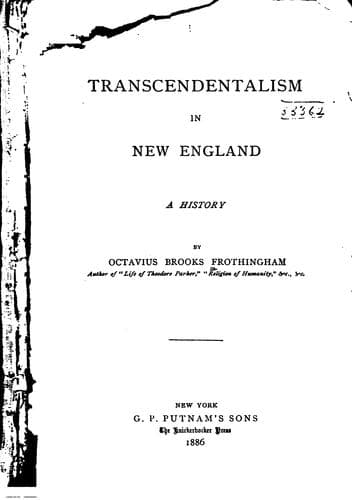
Transcendentalism in New England: A HistoryFrothingham, Octavius Brooks
Philosophy
Transcendentalism in New England: A History
Frothingham, Octavius Brooks
Transcendentalism (New England)
"Margaret was, to persons younger than herself, a Makaria and
Natalia. She was wisdom and intellectual beauty, filling life with
a charm and glory 'known to neither sea nor land.' To those of her
own age, she was sibyl and seer,--a prophetess, revealing the
future, pointing the path, opening their eyes to the great aims
only worthy of pursuit in life. To those older than herself, she
was like the Euphorion in Goethe's drama, child of Faust and
Helen,--a wonderful union of exuberance and judgment, born of
romantic fulness and classic limitation. They saw with surprise her
clear good sense, balancing her flow of sentiment and ardent
courage. They saw her comprehension of both sides of every
question, and gave her their confidence, as to one of equal age,
because of so ripe a judgment."
"An interview with her was a joyous event; worthy men and women who
had conversed with her, could not forget her, but worked bravely on
in the remembrance that this heroic approver had recognized their
aims. She spoke so earnestly, that the depth of the sentiment
prevailed, and not the accidental expression, which might chance to
be common. Thus I learned the other day, that in a copy of Mrs.
Jameson's 'Italian Painters,' against a passage describing Coreggio
as a true servant of God in his art, above sordid ambition, devoted
to truth, 'one of those superior beings of whom there are so few;'
Margaret wrote on the margin: 'And yet all might be such.' The book
lay long on the table of the owner, in Florence, and chanced to be
read there by an artist of much talent. 'These words' said he,
months afterwards, 'struck out a new strength in me. They revived
resolutions long fallen away, and made me set my face like a
flint.'"
"'Yes, my life is strange;' she said, 'thine is strange. We are,
we shall be, in this life, mutilated beings, but there is in my
bosom a faith, that I shall see the reason; a glory, that I can
endure to be so imperfect; and a feeling, ever elastic, that fate
and time shall have the shame and the blame, if I am mutilated. I
will do all I can,--and if one cannot succeed, there is a beauty in
martyrdom.'"
"'Would not genius be common as light if men trusted their higher
selves?'"
Public-domain text, read in full here on John Shaqi.
Reviews
Reviews
No reviews yet
Be the first to share your thoughts on this work.
Elsewhere in the archive
Join the Discussion
Join the discussion
Sign in to leave a comment or review.
Sign InorCreate an account