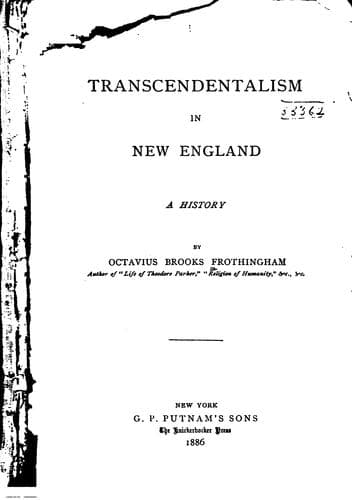
Transcendentalism in New England: A HistoryFrothingham, Octavius Brooks
Philosophy
Transcendentalism in New England: A History
Frothingham, Octavius Brooks
Transcendentalism (New England)
"She won the confidence and affection of those who attracted her,
by unbounded sympathy and trust. She probably knew the cherished
secrets of more hearts than any one else, because she freely
imparted her own. With a full share both of intellectual and of
family pride, she preëminently recognized and responded to the
essential brotherhood of all human kind, and needed but to know
that a fellow being required her counsel or assistance, to render
her not merely willing, but eager to impart it. Loving ease,
luxury, and the world's good opinion, she stood ready to renounce
them all, at the call of pity or of duty. I think no one, not
radically averse to the whole system of domestic servitude, would
have treated servants, of whatever class, with such uniform and
thoughtful consideration--a regard which wholly merged their
factitious condition in their antecedent and permanent humanity. I
think few servants ever lived weeks with her, who were not
dignified and lastingly benefited by her influence and her
counsels. They might be at first repelled, by what seemed her too
stately manner and exacting disposition, but they soon learned to
esteem and love her.
"I have known few women, and scarcely another maiden, who had the
heart and the courage to speak with such frank compassion, in mixed
circles, of the most degraded and outcast portion of the sex. The
contemplation of their treatment, especially by the guilty authors
of their ruin, moved her to a calm and mournful indignation, which
she did not attempt to suppress nor control. Others were willing to
pity and deplore; Margaret was more inclined to vindicate and to
redeem.
"'In the chamber of death,' she wrote, 'I prayed in very early
years: "Give me truth; cheat me by no illusion." O, the granting of
this prayer is sometimes terrible to me! I walk over burning
ploughshares, and they sear my feet; yet nothing but truth will do;
no love will serve that is not eternal, and as large as the
universe; no philanthropy, in executing whose behests I myself
become unhealthy; no creative genius which bursts asunder my life,
to leave it a poor black chrysalid behind; and yet this last is too
true of me.'"
Public-domain text, read in full here on John Shaqi.
Reviews
Reviews
No reviews yet
Be the first to share your thoughts on this work.
Elsewhere in the archive
Join the Discussion
Join the discussion
Sign in to leave a comment or review.
Sign InorCreate an account