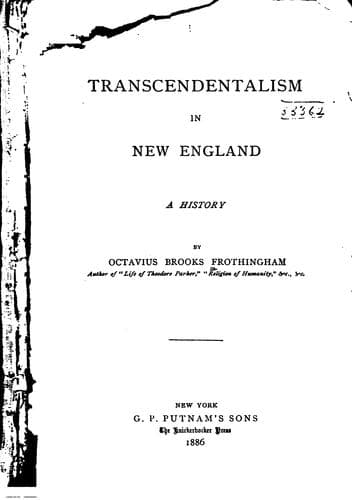
Transcendentalism in New England: A HistoryFrothingham, Octavius Brooks
Philosophy
Transcendentalism in New England: A History
Frothingham, Octavius Brooks
Transcendentalism (New England)
Margaret Fuller did justice to the character of Fourier, admired his
enthusiasm, honored his devotion, acknowledged the terrible nature of
the evils he gave the study of a life-time to correct, and paid an
unstinting tribute to the disinterested motives that impelled him; but
with his scheme for refashioning society she had no sympathy. William H.
Channing was an intimate friend, whose sincerity had her deepest
respect, whose enthusiasm won her cordial admiration; she listened to
his brilliant expositions of socialism, but was not persuaded. Practical
difficulties always appeared, and she never could believe that any
rearrangement of circumstances would effect the regeneration of mankind.
She was acquainted from the first with the experiment of Brook Farm;
knew the founders of it; watched with genuine solicitude the
inauguration of the scheme and its fortunes; talked over the principles
and details of it with the leading spirits; visited the community;
examined for herself the working of the plan; gave her talent to the
entertainment and edification of the associates; discerned with clear
eye the distinctions between this experiment and those of European
origin; but still questioned the practical wisdom of the institution,
and declined to join the fraternity, even on the most flattering terms,
for the reason that, interested as she was in the experiment, it was, in
her judgment, too purely an experiment to be personally and practically
sanctioned by one who had no more faith in its fundamental principles
than she.
She was not to be thrown off from her essential position, the primacy
and all sufficiency of the soul. No misery or guilt daunted her, no
impatience at slowness tempted her to resort to artificial methods of
cure. Her visit to Sing Sing, and her intercourse with the abandoned
women there was exceedingly interesting in this view.
"'They listened with earnest attention, and many were moved to
tears. I never felt such sympathy with an audience as when, at the
words "Men and Brethren," that sea of faces, marked with the scars
of every ill, were up-turned, and the shell of brutality burst
apart at the touch of love. I knew that at least heavenly truth
would not be kept out by self complacence and dependence on good
appearances.... These women were among the so-called worst, and all
from the lowest haunts of vice. Yet nothing could have been more
decorous than their conduct, while it was also frank; and they
showed a sensibility and sense of propriety which would not have
disgraced any society.'"
Public-domain text, read in full here on John Shaqi.
Reviews
Reviews
No reviews yet
Be the first to share your thoughts on this work.
Elsewhere in the archive
Join the Discussion
Join the discussion
Sign in to leave a comment or review.
Sign InorCreate an account