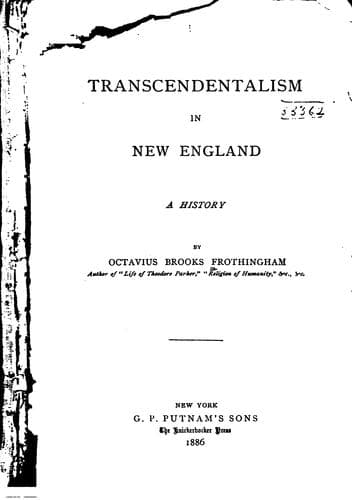
Transcendentalism in New England: A HistoryFrothingham, Octavius Brooks
Philosophy
Transcendentalism in New England: A History
Frothingham, Octavius Brooks
Transcendentalism (New England)
"To learn what I could about the spiritual faculties of man, I not
only studied the sacred books of various nations, the poets and
philosophers who professedly treat thereof, but also such as deal
with sleep-walking, dreams, visions, prophecies, second-sight,
oracles, ecstasies, witchcraft, magic-wonders, the appearance of
devils, ghosts, and the like. Besides, I studied other works which
lie out from the regular highway of theology; the spurious books
attributed to famous Jews and Christians; Pseudepigraphy of the Old
Testament, and the Apocrypha of the New; with the strange fantasies
of the Neoplatonists and Gnostics."
Very important reading all this for one who studied to qualify himself
to instruct his fellow men in the natural history of the world's
religions; but not so valuable as illustrating the "instinctive
intuitions of human nature." Kant, Fichte, Schelling, Hegel, Boehme,
Eckardt, never worked by that method, which may properly be called the
method of Sensationalism applied to Transcendentalism. Parker, on the
religious side, was a pure Transcendentalist without guile, accepting
the transcendental ideas with no shadow of qualification; stating them
with the concrete sharpness of scientific propositions, and applying
them with the exactness of mathematical principles. He took them as he
found them in the writings of the great German thinkers; shaped them as
he, better than any body else, could shape thought in form of words,--as
he shaped the formula of republican government--"government of the
people, by the people, for the people"--from the looser statement of
Daniel Webster,--and laid them down as corner-stones of a new
theological structure. The materials were furnished by Schleiermacher,
Spinoza, Jacobi, Schelling; the architectural skill was his own.
Consciousness he did not undertake to analyze; the "facts of
consciousness" he took on others' verification; their spiritual import
he perceived, developed and applied. Transcendentalism put into his
hands the implements he was in special need of.
Public-domain text, read in full here on John Shaqi.
Reviews
Reviews
No reviews yet
Be the first to share your thoughts on this work.
Elsewhere in the archive
Join the Discussion
Join the discussion
Sign in to leave a comment or review.
Sign InorCreate an account