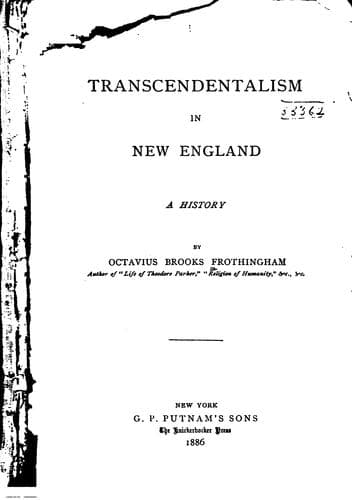
Transcendentalism in New England: A HistoryFrothingham, Octavius Brooks
Philosophy
Transcendentalism in New England: A History
Frothingham, Octavius Brooks
Transcendentalism (New England)
It is not easy to determine the precise period at which Parker fully
accepted, with all its consequences, the transcendental philosophy. He
was not a Transcendentalist--not distinctly and avowedly one--at the
time of his ordination, in 1837; he clearly was in 1840, the date of
the Levi Blodgett letter, which contains the most thorough-going
statement of the transcendental idea to be found in any single tractate.
The probability is, that he always was one in sentiment, and became more
and more consciously one in thought, as he found it necessary to shift
his position in order to save his faith. So long as the beliefs he
cherished seemed to be satisfactorily supported on the old grounds, he
was content; but as the old grounds, one after another, gave way, the
beliefs were transferred to the keeping of new principles. Then the
sentiments of his youth hardened into ideas; the delicate creatures that
lived and gleamed beneath the waters of faith's tropical ocean, became
reefs of white stone, that lifted their broad surface above the level of
the sea, and offered immovable support to human habitations.
Parker was, more than anything, a preacher;--preacher more than
theologian, philosopher or scholar. Whatever else he was, contributed to
his greatness in this. He had a profuse gift of language; expression was
a necessity to him; his thoughts came swiftly, and clothed in attractive
garments; he had wit, and he had humor; laughter and tears were equally
at his command. His resources of illustration, drawn from history,
literature, biography, nature, were simply inexhaustible; the fruits of
enormous reading were at the immediate disposal of a memory that never
lost a trifle of the stores committed to it. The religious emotions were
as genuine with him as they were quick, and as deep as they were
glowing: the human sympathies were wide as the widest, and tender as
the tenderest. He had the power of persuasion and of rebuke, a withering
sarcasm, a winning compassion. His indignation at wrong was not so
qualified by sentimental regard for the wrong doer that invective was
wasted on lifeless abstractions, nor was his judgment of evil doers so
austere that wickedness escaped by being made incredible. It cannot be
said of anybody that he has been able to discriminate nicely, in hours
of moral feeling, between wrong doers and wrong deeds; that cannot be
done in the present state of psychological science. We simply do not
know what the limits of personal responsibility are; how much power is
entrusted to the will; how much allowance is to be made for temperament
and circumstance; at what point the individual is detached from the mass
of mankind, and constituted an accountable person. Parker was guilty, as
others are, of personal injustice in holding individuals answerable for
sins of their generation, and for vices transmitted with their blood;
conscience and charity were occasionally at issue with him; but if
Public-domain text, read in full here on John Shaqi.
Reviews
Reviews
No reviews yet
Be the first to share your thoughts on this work.
Elsewhere in the archive
Join the Discussion
Join the discussion
Sign in to leave a comment or review.
Sign InorCreate an account