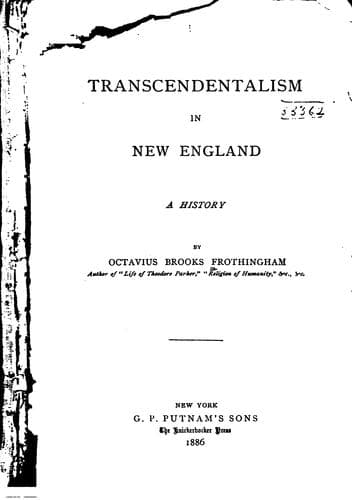
Transcendentalism in New England: A HistoryFrothingham, Octavius Brooks
Philosophy
Transcendentalism in New England: A History
Frothingham, Octavius Brooks
Transcendentalism (New England)
"Men of science, as a class, do not war on the truths, the goodness
and the piety that are taught as religion, only on the errors, the
evil, the impiety which bear its name. Science is the natural ally
of religion. Shall we try and separate what God has joined? We
injure both by the attempt. The philosophers of this age have a
profound love of truth, and show great industry and boldness in
search thereof. In the name of truth they pluck down the
strongholds of error--venerable and old.
"All the attacks made on religion itself by men of science, from
Celsus to Feuerbach, have not done so much to bring religion into
contempt as a single persecution for witchcraft, or a Bartholomew
massacre made in the name of God."
Parker had human sympathies strong and deep, and could never have been
indifferent to the pains and misery of his fellow creatures; yet these
sympathies owed their persistency, their endurance, and their
indomitable sweetness, to the spiritual faith which he professed. He had
a passionate head-strong nature; he knew the charm of pleasant looks,
congenial companions, elegant and luxurious circumstances. His love of
leisure was keen; it was the desire of his life to enjoy the scholar's
privilege of uninterrupted hours, in the delicious seclusion of the
library. With a different philosophy he would have been a very different
man. The creed he held made self-indulgence impossible.
"I have always taught," he said--in a sermon before quoted, the last he
preached in the Melodeon--"that the religious faculty is the natural
ruler in all the commonwealth of man; the importance of religion, and
its commanding power in every relation of life. This is what I have
continually preached, and some of you will remember that the first
sermon I addressed to you was on this theme:--The absolute necessity of
religion for safely conducting the life of the individual, and the life
of the State. You knew very well I did not begin too soon; yet I did not
then foresee that it would soon be denied in America, in Boston, that
there was any law higher than an Act of Congress." The allusion is to
the Fugitive Slave Bill then recently enacted, which brought to a close
issue the controversy between the Abolitionists and the Government, and
imposed on Mr. Parker and the rest who felt as he did, duties of
watchfulness and self-denial, that for years put to flight all thoughts
of personal ease.
He continues:
Public-domain text, read in full here on John Shaqi.
Reviews
Reviews
No reviews yet
Be the first to share your thoughts on this work.
Elsewhere in the archive
Join the Discussion
Join the discussion
Sign in to leave a comment or review.
Sign InorCreate an account