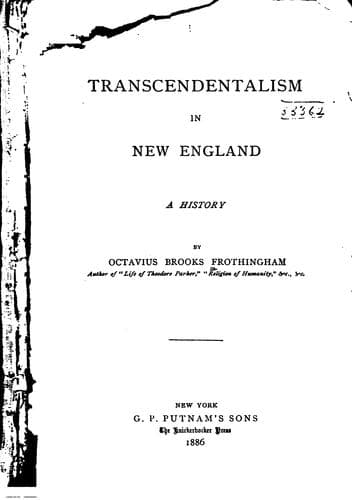
Transcendentalism in New England: A HistoryFrothingham, Octavius Brooks
Philosophy
Transcendentalism in New England: A History
Frothingham, Octavius Brooks
Transcendentalism (New England)
"Woman I have always regarded as the equal of man--more nicely
speaking, the equivalent of man; superior in some things, inferior
in some others; inferior in the lower qualities, in bulk of body
and bulk of brain; superior in the higher and nicer qualities--in
the moral power of conscience, the loving power of affection, the
religious power of the soul; equal on the whole, and of course
entitled to just the same rights as man; the same rights of mind,
body and estate; the same domestic, social, ecclesiastical, and
political rights as man, and only kept from the enjoyment of these
by might, not right; yet herself destined one day to acquire them
all."
The belief in the spiritual eminence of woman was part of the creed of
the Transcendentalist; it was intimately connected with his reverence
for interior, poetic, emotional natures; with his preference for feeling
above thought, of spontaneity above will. In the order of rank, Parker
assigned the first place to the "religious faculty," as he termed it,
which gave immediate vision of spiritual truth; the second place was
given to the affections; conscience he ranked below these; and lowest of
all stood the intellect. The rational powers were held subordinate to
the instinctive, or rather the rational and the instinctive were held to
be coincident. The feminine characteristic being affection, which is
spontaneous, and the masculine being intellect, which is not, the
feminine was set above the masculine--love above light, pity above
justice, sympathy above rectitude, compassion above equity. Parker had
feminine attributes, and was slightly enamored of them; thought, or
tried to think them the glory of his manhood; but the masculine greatly
predominated in him. To people in general he seemed to reverse his own
order, in practice. Weak, dependent, dreamy men he had no patience with;
sentimentalism was his aversion; the moral element alone commanded his
absolute respect. Masculine women were equally distasteful; while he
admired the genius of Margaret Fuller, his personal attraction toward
her seldom brought him into her society. That a man constituted as he
was, self-reliant to aggressiveness, inclined to be arbitrary,
dogmatical, and imperious, of prodigious force of will and masterly
power of conscience, entered as he did into advocacy of the rights of
the African and the prerogatives of woman, is evidence of the
whole-heartedness with which he adopted the transcendental philosophy.
It was, indeed, a faith to him, that ruled his life and appointed his
career. It gave him his commission as prophet, reformer, philanthropist.
It was the consecrating oil that sanctified him, from the crown of his
head to the soles of his feet.
Public-domain text, read in full here on John Shaqi.
Reviews
Reviews
No reviews yet
Be the first to share your thoughts on this work.
Elsewhere in the archive
Join the Discussion
Join the discussion
Sign in to leave a comment or review.
Sign InorCreate an account