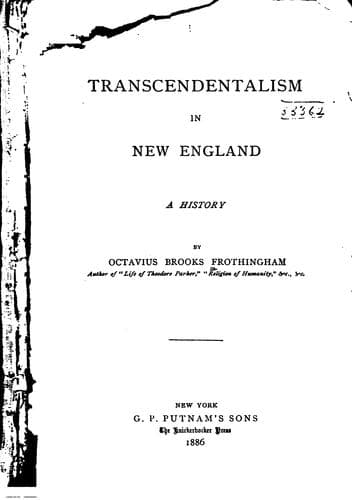
Transcendentalism in New England: A HistoryFrothingham, Octavius Brooks
Philosophy
Transcendentalism in New England: A History
Frothingham, Octavius Brooks
Transcendentalism (New England)
Parker believed in the gospel of Transcendentalism, and was fully
persuaded that it was to be the gospel of the future. "The religion I
preach," he was accustomed to say, "will be the religion of enlightened
men for the next thousand years." He anticipated an earthly immortality
for his thought, an extensive circulation of his books, a swift course
for his word, among the people. The expectation seemed not unreasonable
twenty years ago.
The prediction has not thus far been justified. Parker died in 1860, on
the eve of the civil war, which he prognosticated, sixteen years ago.
The war fairly ended, efforts were made to revive the prophet's memory
and carry out the cherished purpose of his heart. But their ill success
has gone far to prove--what needed no evidence--that prophecies may
fail, and tongues cease and knowledge pass away. The philosophy that
Parker combated and ridiculed and cast scorn at, declared to be
self-refuted and self-condemned, has revived under a new name, as the
"philosophy of experience," is professed by the ablest thinkers of the
day, taught in high places, in the name of science, set forth as the
hope of man; the creeds he pronounced irrational, and fancied to be
obsolete still hold nominal sway over the minds of men; the Christianity
of the letter and the form is the only Christianity that is officially
acknowledged; the gospel is an institution still, not a faith;
revivalism has the monopoly of religious enthusiasm; preaching is giving
place to lecturing; the pulpit has been taken down; science alone is
permitted to speak with authority;--literature, journalism, politics,
trade, attract the young men that once sought the ministry; the noble
preachers of a noble gospel are the few remaining idealists, who have
kept the faith of their youth; they are growing old; one by one they
leave their place, and there are none like them to fill it. Parker was
one of the last of the grand preachers who spoke with power, bearing
commission from the soul. The commissions which the soul issues are, for
the time being, discredited, and discredited they will be, so long as
the ideal philosophy is an outcast among men. Should that philosophy
revive, the days of great preaching will return with it. Bibles will be
read and hymns sung, and sermons delivered to crowds from pulpits. The
lyceum and the newspaper will occupy a subordinate position as means of
social and moral influence, and the prophets will recover their waning
reputation. Until then, the work they did when living must attest their
greatness with such as can estimate it at its worth.
XIII.
THE MAN OF LETTERS.
Public-domain text, read in full here on John Shaqi.
Reviews
Reviews
No reviews yet
Be the first to share your thoughts on this work.
Elsewhere in the archive
Join the Discussion
Join the discussion
Sign in to leave a comment or review.
Sign InorCreate an account