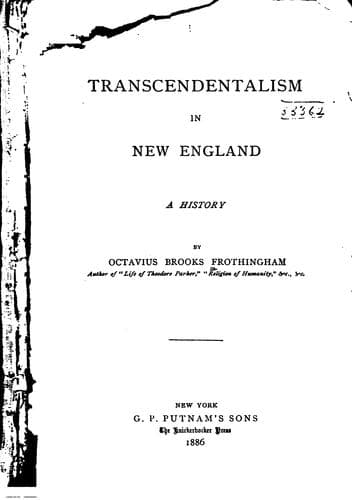
Transcendentalism in New England: A HistoryFrothingham, Octavius Brooks
Philosophy
Transcendentalism in New England: A History
Frothingham, Octavius Brooks
Transcendentalism (New England)
The man who was as influential as any in planting the seeds of the
transcendental philosophy in good soil, and in showing whither its
principles tended, is known now, and has from the first been known,
chiefly as a man of letters, a thoughtful observer, a careful student
and a serious inquirer after knowledge. George Ripley, one year older
than Emerson, was one of the forerunners and prophets of the new
dispensation. He was by temperament as well as by training, a scholar, a
reader of books, a discerner of opinions, a devotee of ideas. A mind of
such clearness and serenity, accurate judgment, fine taste, and rare
skill in the use of language, written and spoken, was of great value in
introducing, defining and interpreting the vast, vague thoughts that
were burning in the minds of speculative men. He was one of the first in
America to master the German language; and, his bent of mind being
philosophical and theological, he became a medium through which the
French and German thought found its way to New England. He was an
importer, reader and lender of the new books of the living Continental
thinkers. His library contained a rich collection of works in
philosophy, theology, hermeneutics, criticism of the Old and New
Testaments, and divinity in its different branches of dogmatics and
sentiment. He was intimate with N. L. Frothingham and Convers Francis,
the admirable scholar, the hospitable and independent thinker, the
enthusiastic and humane believer, the centre and generous distributor of
copious intellectual gifts to all who came within his reach. Theodore
Parker was the intellectual product of these two men, Convers Francis
and George Ripley. The former fed his passion for knowledge; the latter,
at the period of his life in the divinity school, gave direction to his
thought. The books that did most to determine the set of Parker's mind
were taken from Mr. Ripley's library. For a considerable time, in
Parker's early ministry, they were close and thoroughly congenial
friends. They walked and talked together; made long excursions; attended
conventions; were members of the same club or coterie; joined in the
discussions at which Emerson, Channing, Hedge, Clark, Alcott took part;
and, though parted, in after life, by circumstances which appointed them
to different spheres of labor,--one in Boston, the other in New
York,--they continued to the end, constant and hearty well wishers. At
the close of his life, Parker expressed a hope that Ripley might be his
biographer.
Public-domain text, read in full here on John Shaqi.
Reviews
Reviews
No reviews yet
Be the first to share your thoughts on this work.
Elsewhere in the archive
Join the Discussion
Join the discussion
Sign in to leave a comment or review.
Sign InorCreate an account