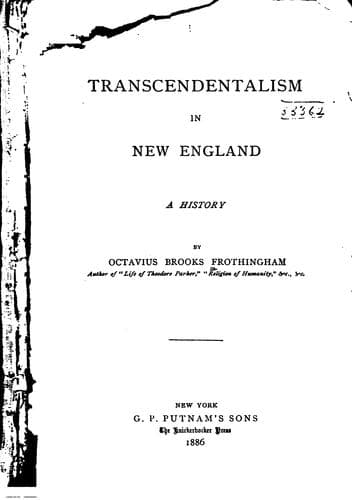
Transcendentalism in New England: A HistoryFrothingham, Octavius Brooks
Philosophy
Transcendentalism in New England: A History
Frothingham, Octavius Brooks
Transcendentalism (New England)
rather than the worst the New World had experienced; and their words met
with no response from the multitudes in whose behoof they were spoken.
America was exercised then by questions of awful moment. The agitation
against slavery had taken hold of the whole country; it was in politics,
in journalism, in literature, in the public hall and the parlor. Its
issues were immediate and urgent. People had neither heads nor hearts
for schemes of comprehensive scope that must be patiently meditated and
matured for generations. No talents, no brilliancy, no earnestness even,
would engage interest in what seemed visionary, however glorious the
vision. The socialistic enterprises in America were all short lived.
Brook Farm was an idyl; and in the days of epics, the idyl is easily
forgotten.
The decease of the "Harbinger" was the end of that phase of
Transcendentalism. The dream of the kingdom of heaven faded. The
apostles were dispersed. Some kept their faith and showed their fidelity
in other places and other work. Three or four went into the Roman
Church, and found rest on its ancient bosom. Others found a field for
their talents in literature, which they beautified with their genius,
and ennobled by their ideas. Others devoted themselves to journalism. Of
the last was George Ripley. _The New York Tribune_ offered him the post
of literary critic on its editorial staff. That position he has occupied
for twenty-five years, in a way honorable to himself and to good
letters. It has been in his power to aid the development of literature
in America, in many ways, by encouraging young writers; by giving
direction to ambitious but immature gifts; by erecting a standard of
judgment, high, without being unreasonable, and strict, without being
austere. A large acquaintance with books, a cultivated taste, a
hospitable appreciation, a hearty love of good literary work, a cordial
dislike of bad, a just estimation of the rights and duties of literary
men, and the office they should fill in a republican community, have
marked his administration of the department assigned to him. He has held
it to be his duty to make intelligent reports of current literature,
with enough of criticism to convey his own opinion of its character,
without dictating opinions to others. Worthless books received their
due, and worthy books received theirs in full measure. The books in
which worth and worthlessness were united were discriminatingly handled,
the emphasis being laid on the better qualities. Many of the reviews
were essays, full of discernment. All showed that respect for mind which
might be expected from one so carefully trained.
Public-domain text, read in full here on John Shaqi.
Reviews
Reviews
No reviews yet
Be the first to share your thoughts on this work.
Elsewhere in the archive
Join the Discussion
Join the discussion
Sign in to leave a comment or review.
Sign InorCreate an account