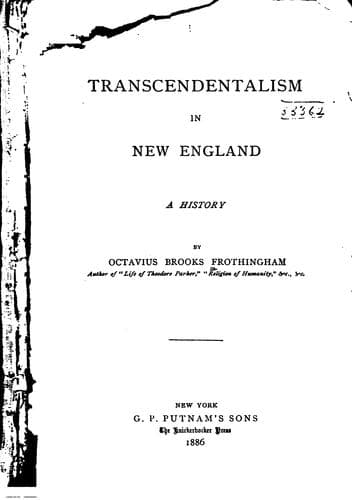
Transcendentalism in New England: A HistoryFrothingham, Octavius Brooks
Philosophy
Transcendentalism in New England: A History
Frothingham, Octavius Brooks
Transcendentalism (New England)
Mr. Ripley has been true to the ideas with which he set out in his early
life. His period of philosophical propagandism being over; his young
enthusiasm having spent itself in experiments which trial proved to be
premature, to say the least, if not essentially impracticable; his
dreams having faded, when his efforts ended in disappointment, he
retired from public view neither dispirited, nor morose. His interest in
philosophy continues undiminished; his hope of man, though more subdued,
is clear; his faith in the spiritual basis of religion is serene.
Disappointment has not made him bitter, reckless or frivolous. His power
of moral indignation at wrong and turpitude is unimpaired, though it no
longer breaks out with the former vehemence. A cheerful wisdom gained by
thought and experience of sorrow, tempers his judgment of men and
measures. His confidence is in culture, in literature, generously
interpreted and fostered, in ideas honestly entertained and freely
expressed.
The Transcendentalist keeps his essential faith. Generally the
Transcendentalists have done this. It was a faith too deeply planted,
too nobly illustrated, too fervent and beautiful in youth, to be laid
aside in age. James Walker died in the ripeness of it; Parker died in
the strength of it; others--old and grave men now--live in the joy of
it. The few who have relapsed, have done so, some under pressure of
worldly seduction--they having no depth of root--and some under the
influence of scientific teaching, which has shaken the foundation of
their psychology. The original disciples, undismayed by the signs of
death, still believe in the Master, and live in the hope of his
resurrection.
XIV.
MINOR PROPHETS.
The so-called Minor Prophets of the Old Testament owed that designation
to the brevity, rather than to the insignificance of their utterances.
They were among the most glowing and exalted of the Hebrew bards, less
sustained in their flight than their great fellows, but with as much of
the ancient fire as any of them. It is proper to say as much as this to
justify the application of the title to the men who claim mention now as
prominent in the transcendental movement.
Public-domain text, read in full here on John Shaqi.
Reviews
Reviews
No reviews yet
Be the first to share your thoughts on this work.
Elsewhere in the archive
Join the Discussion
Join the discussion
Sign in to leave a comment or review.
Sign InorCreate an account