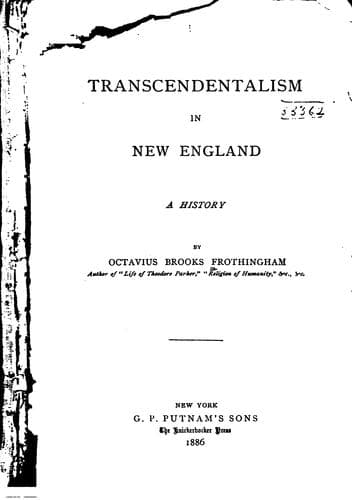
Transcendentalism in New England: A HistoryFrothingham, Octavius Brooks
Philosophy
Transcendentalism in New England: A History
Frothingham, Octavius Brooks
Transcendentalism (New England)
William Henry Channing is not quite fairly ranked among minor prophets,
even on this explanation, for he has been copious as well as intense. A
nephew of the great Doctor Channing--a favorite nephew, on account of
his moral earnestness, and the close sympathy he felt with views that
did honor to human nature and glorified the existence of man,--he grew
up in the purest atmosphere that New England supplied--the most
intellectual, the most quickening. He was born in the same year with
Theodore Parker, and but three months earlier, and was native to the
same spiritual climate. He was educated at Harvard, and prepared for the
ministry at Cambridge Divinity School, where the new ideas were
fermenting. He was graduated the year before Parker entered. His name
was conspicuous among the agitators of the new faith. He was a
contributor to the "Dial." In 1848 he published the Memoirs of his
uncle, in three volumes, proving his fitness for the task by the
sincerity in which he discharged it. In 1840 he translated Jouffroy's
Ethics, in two volumes, for Ripley's "Specimens of Foreign Standard
Literature." In 1852 he took part in writing the Memoirs of Margaret
Fuller, the second volume being chiefly his work. "The Life and Writings
of James H. Perkins," of Cincinnati, a pioneer of rationalism at the
West, came more fitly from his pen than from any other. In the "Western
Messenger," which he edited for one year; the "Present," and the "Spirit
of the Age," short-lived journals, of which he was the soul; in the
"Harbinger," to which he was a generous and sympathetic contributor--he
exhibited a fine quality of genius. The intensity of his nature, his
open-mindedness, frankness, and spiritual sensitiveness, his fervency of
aspiration and his outspokenness, made the office of settled pastor and
steady routine preacher distasteful to him. He was a prophet who went
from place to place, with a message of joy and hope. Meadville,
Cincinnati, Nashua, Rochester, Boston, and New York, were scenes of his
pastoral service. His preaching was every where attended by the clearest
heads and the deepest hearts. In New York his society was composed of
free elements altogether, come-outers, reformers, radicals of every
description. His command of language, his free delivery, his musical
voice, his expressive countenance, his noble air, his extraordinary
power of kindling enthusiasm, his affluence and boldness of thought, his
high standard of character, made him in his prime an enchanting speaker.
Public-domain text, read in full here on John Shaqi.
Reviews
Reviews
No reviews yet
Be the first to share your thoughts on this work.
Elsewhere in the archive
Join the Discussion
Join the discussion
Sign in to leave a comment or review.
Sign InorCreate an account